
Red Night Light: What It's For, Who It's For and Its Limits
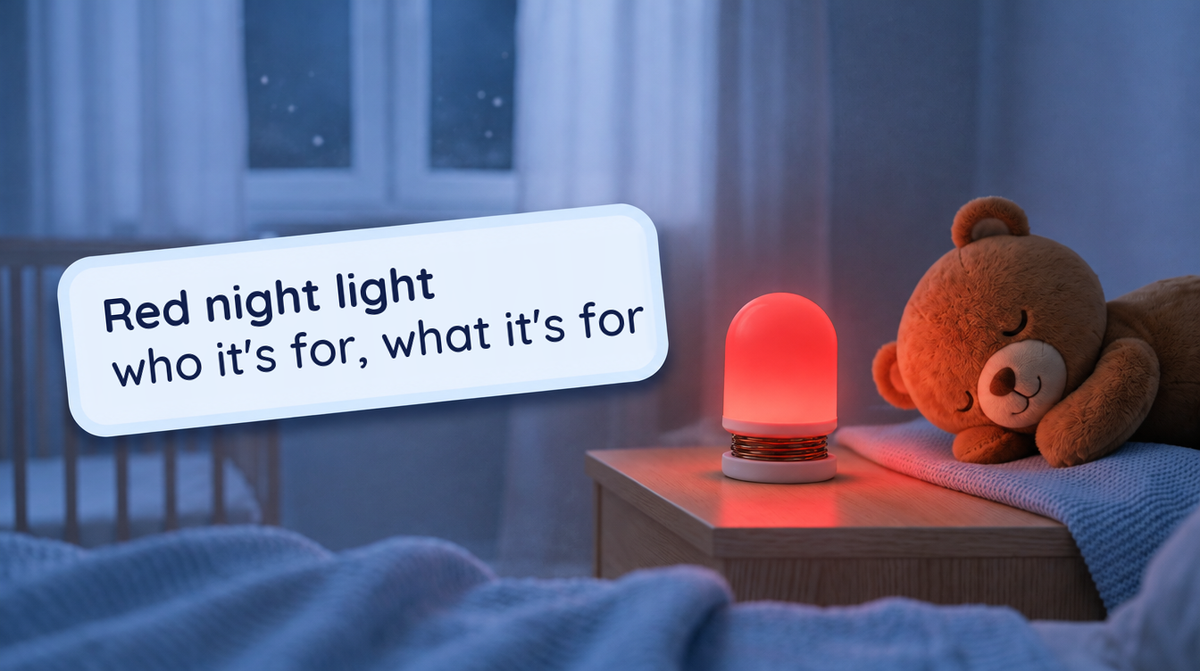
A red night light is mainly for the night: feeds, nappy changes and night waking. It gives just enough light to see, without blue light, the kind that holds back melatonin. It has two limits: it shows colours poorly and it has to stay very dim. Amber takes over when you need to see better.
It's 3 a.m., your baby is crying for you, and you're feeling around for a nappy so you don't have to switch on the ceiling light. This is exactly the moment the red night light was designed for: a glow that lets you see what you're doing without turning the room into broad daylight.
Red isn't the right answer to every situation in the night, though, and amber sometimes does better. You'll find both shades on cordless models you can put wherever you need them, among our portable and rechargeable night lights.
Why a red light at night?
A red light lets you see at night with a glow that contains practically no blue. And it is mainly blue light, the kind given off by screens and LEDs, that holds back melatonin.
Light and the body clock
Melatonin is known as the sleep hormone. Light, mainly blue light, can suppress its production and throw the body clock out of sync.
Anses, the French Agency for Food, Environmental and Occupational Health & Safety, notes that exposure to blue-rich light in the evening or at night, even at a very low level, disrupts biological rhythms. Hence the right way to use a night light: switched on for the task, at its lowest setting, then switched off.
Blue light versus red light
A study by an Inserm team in Lyon (Inserm is France's national institute for health and medical research), published in 2023 in the Journal of Pineal Research and reported by the French medical reference Vidal in 2024, shows that in young adults, the drop in melatonin caused by blue light works through melanopsin, a photoreceptor in the retina.
For its part, Anses advises "warm white" home lighting and recommends limiting the blue-rich light from screens before bedtime and during the night, especially for children. Red takes this logic all the way: no white at all, only the shade furthest from blue.
This article gives general guidance on light and sleep; it does not replace medical advice. A night light does not treat night waking or sleep problems. If your child's sleep worries you, talk to your GP or a paediatrician.
For more detail on recommended lights and how to set the brightness, our article on leaving a night light on all night sums up what sleep science says.
Red night light for babies: feeds, changes, night waking
A red night light for babies is first and foremost for the parent, not the baby. In the early months, you're the one who switches it on to feed, change or check, and you're the one who needs to see.
Breastfeed or bottle
Enough light to position your baby and see the bottle, without lighting up the room.
The night-time nappy change
You can see what you're doing, the poppers on the vest, the nappy. Not the detail of colours (see below).
A quick check
Make sure your baby is asleep and properly covered, without lighting up the room.
Back to bed
Get back to your own bed with the minimum of light, without any bright light.
A red night light won't make your baby sleep longer; no object can. It simply avoids adding bright light to a waking that is already happening. That's also why it deserves a place in your hospital bag: our guide on which night light to take for your maternity stay explains how to choose one for a hospital room.
The limits of red light, rarely mentioned
Red light has three practical limits: it hides colours, it doesn't make up for a brightness that is too high, and not everyone likes it.
1. Under red light, all colours look alike
A red light reflects almost nothing but red. A white vest looks pink, a clean nappy and a dirty one look the same, a red patch on the skin disappears. That's the physics of light, not a manufacturing fault.
In practice, keep red for the tasks you know by heart, and change the light as soon as you really need to look.
- Nappy rash, spots, patches: redness can't be seen under red light. Switch to amber or a warm lamp while you take a look.
- Stools and spit-up: their colour can sometimes tell you something, and red erases it. To judge it, you need a different light.
- Your baby's skin colour: paleness or skin that changes colour can't be read under red. If in doubt, switch the light on properly: health comes before sleep.
- Medicine doses, bottle markings: small numbers are hard to read in a dim red glow. Prepare what needs preparing before night falls, or use amber.

2. Brightness matters too
A red light that is too bright is still a bright light.
Young children are also very sensitive to evening light. In a University of Colorado study published in 2022 in the Journal of Pineal Research, one hour of light before bedtime, even between 5 and 40 lux, lowered melatonin by 78% on average in children aged 3 to 5. This study did not use red light, but it shows that "dim" light is not necessarily neutral.
The right habit: the lowest brightness that lets you do the task, the night light placed away from the bed, and switched off once you've finished.
3. Some children don't like red
A newborn has no opinion about colour. A 2- or 3-year-old who is starting to imagine things in the dark, on the other hand, may find a red room strange, even frightening.
If your child asks for "the other light", don't force it. Amber or a soft orange are still warm shades: better a night light your child accepts. Our article on fear of the dark in children offers ideas for this age.
Red for night-time tasks, amber for looking or reassuring.
Red, amber or orange: which shade, and when?
Red suits quick tasks in the middle of the night, amber the moments when you need to see better or to reassure, and soft orange the older child. The table below sums up the choice by moment and by person.
| Time of night | Recommended shade | Brightness | Why |
|---|---|---|---|
| Night feed or bottle | Red | The lowest | Enough to position your baby, no blue at all |
| Quick nappy change | Red | Low | Familiar actions, no need to see colours |
| Checking skin, a stool, sick | Amber, or a warm lamp for a moment | Medium, then off | Red hides redness and colours |
| Preparing a bottle, measuring a medicine | Amber | Medium | Reading markings needs more contrast |
| Bedtime routine, story | Amber or very warm white | Low to medium | You read and look at the pictures, then dim |
| Child aged 2 and over who doesn't like red | Amber or soft orange | Low | A warm shade they accept, so the night light gets used |
| Adult getting up in the night | Red | The lowest | Find your way with the minimum of light |
| Adult reading while the other person sleeps | Amber | Medium, directed | Text is hard to read under red |

A night light that offers both shades means you don't have to choose once and for all. That's the case with the Amber and Red version of our portable night light, shown below.
How to choose a red night light
A good red night light has no hidden white light, dims very low, switches on with one hand and sits away from the bed. The rest, shape or design, is a matter of taste.
A true red light, with no white
Many "multicolour" night lights go through white or blue before they reach red. At 3 a.m., that moment is enough to dazzle you. Check on the product page that the model has no white light at all.
A brightness that dims very low
Several levels, or continuous dimming, let you find the level that is just enough. A night light with a single brightness level can be too bright at night.
Rechargeable, so you can put it where you need it
Cordless, it sits on the chest of drawers, goes in your hand for the change, comes along to the maternity ward or on holiday. A portable night light also avoids a cable trailing near the bed.
Simple, one-handed controls
A press or a light touch, without hunting for a tiny button in the dark: your other hand is holding the baby.
Away from the bed and out of reach
The night light goes away from the bed, never in it. Check the age shown on each product page: some are designed to be handled by children from 18 months, others are for adults only.
For the other criteria (material, timer, where to put it in the room), our comparison which portable rechargeable night light to choose goes through them one by one.
Our selection
Our portable red and amber night light was chosen for one simple reason: it has no white light at all. It comes in three versions, each matching a use from the table above.
| Version | Light | Settings | Who it's for, when |
|---|---|---|---|
| Red | Red only (625 to 630 nm according to the product page) | 3 brightness levels | Feeds, quick changes, adults getting up in the night |
| Amber | Amber only (1,600 K according to the product page) | 3 brightness levels | Bedtime, children who don't like red, gentle reading |
| Amber and Red | Both shades | Continuous dimming; the colours cycle with each press before it switches off | Parents who want red for the night and amber for looking |
All three versions share the rest: USB-C charging with the cable included, up to 28 hours of battery life on the lowest light (less at full brightness), 9 cm tall and 110 g. The product page reserves it for adult use: in a baby's room, it goes out of reach, and you're the one who uses it.
 Red light Portable Rechargeable Night Light with Red and Amber Light Red or amber, with no white light at all, 3 brightness levels, a spring-mounted dome that switches on with a simple press. £45.90 View the night light
If your child prefers a warm glow to red, these silicone night lights are designed for a baby's room: from birth in the bedroom, to be handled by the child from 18 months, according to their product pages.
 Warm light LED Duck Night Light for Babies Warm light with touch-adjustable brightness, 15-minute timer, BPA-free silicone, designed for night-time bottles and nappy changes. £39.90 View the night light
 Warm light Silicone Duck Night Light Warm light, 3 touch brightness levels, 30-minute timer, USB rechargeable. £43.90 View the night light
 For the bedtime routine Candle Night Light Flameless silicone candle, 2 touch light levels, 30-minute timer and 6 hours of battery life. £38.90 View the night light
More warm-light night lights, animal-shaped or more understated, are waiting in our baby night light collection.
Until what age should you keep a red light?
Red light is mainly useful as long as there are night feeds, bottles and nappy changes, so in the early months. After that, the question is no longer age but use: a child who sleeps through no longer needs their room lit in the middle of the night.
- Early months: red for night-time tasks, used by the parent, night light out of reach.
- When night-time care becomes less frequent: a warm glow at its lowest, or a timer, for the few times you still need to switch on.
- From 2 or 3 years: if fear of the dark appears, your child chooses the shade. Red if they accept it, amber or orange if not.
Our article what age to use a night light for your baby sets out the milestones month by month, with the recommended colour at each stage.
Red light for adults
A red night light isn't only for the baby's room. For adults, it helps in three situations: getting up in the night without lighting the room, watching over a loved one without shining a light on them, and sharing a room with someone who is asleep.
To go to the loo or get a glass of water, red at the lowest brightness is enough to find your way. To read while the other person sleeps, however, text is hard to read under red. Amber, aimed at the book, is more comfortable.
- Night feeds and nappy changes
- Getting up with the minimum of light
- Checking on a sleeping loved one
- A shared room, a hotel, the maternity ward
- Looking at skin, a stool, a complexion
- Reading text or bottle markings
- The bedtime routine and stories
- A child who doesn't like red
Other bedside lights designed for grown-ups, with warm light, touch controls or a rechargeable battery, are gathered in our adult night lights.
FAQ: your questions about red night lights
Why choose a red night light?
A red night light lets you see at night without the blue light of screens and white LEDs, known to hold back melatonin production. It suits quick tasks, a feed, a change or getting up in the night, as long as it stays at the lowest brightness and sits away from the bed.
Is red light good for a baby's sleep?
Red light doesn't make a baby sleep, but it contains practically no blue light, the kind that Anses, the French health and safety agency, advises limiting at night, especially for children. Brightness matters too: a very dim red glow, switched off after the task, is the right way to use it. This is not medical advice.
Can you leave a red night light on all night?
A red night light can stay on if it is very dim and out of your child's line of sight, but a dark room is still better for the whole night. The simplest approach is to switch it on for the task, then off again, or to use a timer.
Red or amber: which colour should you choose?
Red suits quick tasks in the middle of the night, amber the moments when you need to see better: checking redness, reading bottle markings, telling a story. A night light that offers both shades, like our Amber and Red version, means you don't have to choose once and for all.
What if my child is afraid of red light?
If a 2- or 3-year-old finds red light frightening, switch to an amber or soft orange shade. These colours are still warm, and a night light your child accepts is better than a shade they dread. Let them choose between two warm settings, such as amber and soft orange.
Why does red light distort colours?
A red light shines almost only in red, so objects can only reflect that colour. A white vest looks pink and a red patch on the skin disappears. To check your baby's skin or stool, switch to amber or a warm lamp while you take a look.
A gentle light for night-time tasks
Red, amber or warm light: find the night light that will see you through your nights with your baby.
VISIT THE SHOP