What Age Should a Baby Use a Night Light? Our Age-by-Age Guide
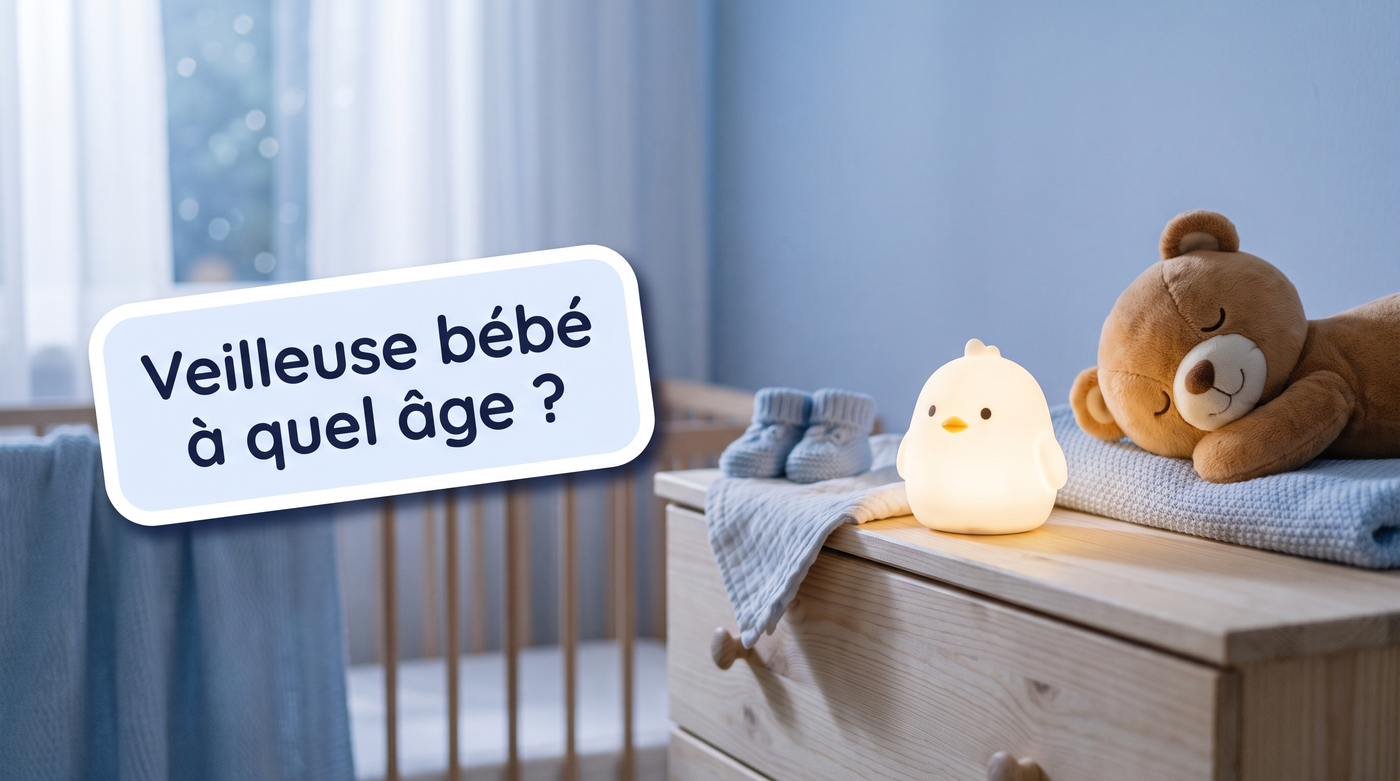
A night light can go in the room from birth, but at first it's really for the parent, for night feeds and nappy changes. Around age 2, when fear of the dark appears, it becomes useful to the child. Keep the light low and warm, place the night light outside the cot, and leave handling it for later.
Working out what age to use a baby night light means separating two uses that are often confused. There's the night light that helps the parent see during night-time care, useful from the very first days. And there's the one the child asks for, switches on and off, and that comes much later. This article follows that line, age by age, from the maternity ward to reception class.
The quick answer: what age should you introduce a night light?
A night light can go in the room from birth. It's not compulsory, and a newborn doesn't need one to sleep. What changes over the months isn't whether the lamp is there, but who it's actually for.
Under 6 months: a night light for parents, not for baby
At this age, your baby doesn't ask for light and doesn't yet know fear of the dark. The night light solves a very practical problem, yours: seeing well enough for a nappy change at 3 am without switching on the ceiling light, and without fully waking your baby.
The right night light at this stage is discreet: warm light, brightness at its lowest, placed outside the cot. It lights up your hands and the changing table, not your baby's face. Many parents only use it for a few minutes a night, when needed, rather than leaving it on.
6 months to 2 years: comfort and visual cues
Between 6 months and 2 years, children start to recognise the things in their room and to understand how bedtime unfolds. The night light becomes a cue: the curtains are closed, it's switched on, and the evening routine always ends the same way. That's what makes this light reassuring, far more than its shape.
It's also the age when children reach out for things. A one-piece soft silicone night light can be handled from 18 months. Designs shaped like a familiar animal work well at this age because they become a character in the room, not just a lamp.
From age 2: reassurance when fear of the dark begins
Fear of the dark often appears around age 2, along with imagination and the first nightmares. This is when the night light stops being a practical accessory and becomes genuinely useful to the child. It makes the room easy to make sense of, which is often enough to ease the anxiety.
At this point, children want to decide for themselves. A night light with a simple button or a touch sensor gives them that independence. As soon as there's a remote control, a button battery, glass or small parts, the child shouldn't handle it until age 3.
And until what age should you keep a night light?
There's no age to stop. Some children do without one around 4, others keep it until 8 or 9, and plenty of adults sleep with a low light in the hallway. The useful rule is simple: remove the night light when your child no longer asks for it, not when a calendar says so.
If you want to stop, lower the brightness gradually over several weeks, then move the lamp towards the door or into the hallway. Stopping abruptly often leads to a step backwards and a few difficult nights.
The night light is useful from the very first nights because it's the parent who uses it. It only passes into the child's hands much later.
Does a newborn really need a night light?
No, a night light isn't necessary for a newborn's sleep. It's practical, which isn't the same thing. Making that distinction avoids two common mistakes: buying one thinking it will improve sleep, or feeling guilty for not having one.
What paediatricians say
No official guidance treats a night light as part of safe-sleep equipment. A night light doesn't make a baby sleep, doesn't shorten night wakings and doesn't replace a bedtime routine. It gives light, that's all, and that's already a lot at 3 am.
This article gives general information. If you're worried about your child's sleep, if night wakings are becoming more frequent or nights are getting difficult, your GP, health visitor or paediatrician is the right person to speak to.
The risks of too much light at night
The real issue isn't the night light, it's how bright it is. A bright white or bluish light wakes the eyes and makes it harder to get back to sleep, for your child and for you. It's also this kind of light that has the most effect on the body clock.
A simple rule of thumb: if you can comfortably read next to the night light, it's too bright for a baby's room. A glow that just lets you make out the outline of the furniture is enough.
- Night-time care without the ceiling light
- A fixed cue in the bedtime routine
- A room that's easy to make sense of when fear of the dark sets in
- Safe trips around the room when your child gets up alone
- It doesn't make a baby sleep
- It doesn't stop night wakings
- It doesn't replace a bedtime routine
- It has no medical effect, on anything
Which light colour for your baby's age?
Colour matters more than the stated power. A warm shade, towards red or amber, is barely noticeable at night and lets the darkness do its job. A cool white light does the opposite: it lights up the room in sharp outline and draws the eye.
Newborn (0-3 months): red or amber light
For the first few weeks, the most discreet light is the best. Red and amber give enough light for a nappy change or a feed without ever feeling like daybreak. Remember that this light is there for you, not for your baby.
Baby (3-12 months): soft orange
After the first few months, a soft orange or a very warm white takes over. It makes the room easier to see during wake-ups, while staying far from daylight. At this stage, keep the brightness the same from one night to the next; your child gets used to it.
Toddler (2 years and up): soft light, adjustable brightness
Around age 2, children have preferences and want their own colour. Multicolour designs meet that wish, as long as you stick to this principle: the chosen colour is for bedtime, and the night is spent on a low, warm shade. Adjustable brightness becomes the number one criterion.
| Age | Recommended colour | Who uses it |
|---|---|---|
| 0 to 3 months | Red or amber, very low | The parent, for night-time care |
| 3 to 12 months | Soft orange or very warm white | The parent; the child gets used to it |
| 1 to 2 years | Steady warm white | A cue in the bedtime routine |
| 2 years and up | Soft, adjustable brightness | The child, when afraid of the dark |
How to choose a night light suited to your child's age
The first filter is age, and it already rules out half the range. Then come five criteria, in this order of importance. You'll find these types sorted by use in our baby night light range, from soft silicone to tabletop designs.

The colour of the light
Check the shade first, then whether it can be dimmed. A design that only offers cool white with no adjustment should be ruled out for a baby's room, whatever it looks like. Warm white is the safe choice at every age.
The features (timer, sensor, projection)
Features are only worth having if they save you getting up. A timer is the most useful before age 1; projection comes into its own from age 2, when your child looks at the ceiling instead of calling for you. Musical baby night lights add a background sound that covers household noise.
It switches off by itself once your child is asleep, without you going back into the room.
One press is all it takes; a 2-year-old can use it alone.
Stars on the ceiling, best kept for bedtime rather than the whole night.
Handy for the parent, but it contains a button battery, so keep it out of reach.
The power source
There are three families: plug-in designs, battery-powered ones and USB rechargeable ones. Rechargeable night lights have the big advantage of moving around, from the bedroom to the bathroom, with no cable trailing near the cot.
Two things to watch: a cable must always run out of reach of the cot, and a battery compartment must be screwed shut. Button batteries mean the age-3 rule applies to handling.
Composition and materials
For a toddler, one-piece soft silicone is the best compromise: nothing to take apart, nothing to break, and a pleasant, washable surface. Glass and small add-on parts are best kept for decorative designs, placed out of reach. Our night lights are CE and RoHS compliant, and checked before dispatch.
 An example Silicone Bunny Night Light Soft, non-toxic silicone, 7 colours via touch sensor, a 0.8 W LED and 10 hours of battery life from 3 hours of charging. View the night light
The shape
Shape is the only criterion where your child's opinion really counts, and only from age 2. Before that, choose for yourself: a simple silhouette blends into the room and lasts for years. After that, an animal or a moon becomes a familiar character, which helps with saying goodnight.
Where to put the night light in the nursery
Where you put it matters as much as which one you choose. Two rules apply at every age: the night light stays out of reach of the cot, and it never shines directly on your child's face. The rest depends on the room.
On the bedside table
This is the most common spot, and it works well as long as the table is far enough from the cot. Check that an outstretched arm can't reach it from the mattress, and run the cable behind the furniture, never across the front.
Away from the cot
Putting the night light at the other end of the room, or plugging it into a low socket near the door, gives a very soft indirect light. It's often the best option before 6 months: you can see where you're walking, and nothing shines in your baby's eyes.
On the wall
Wall mounting settles the question of reach once and for all. Above the changing table or the chest of drawers, it lights the area you need during night-time care and frees up the top of the furniture.
 Along these lines Wall Night Light for Baby's Room Warm white LED backlighting over an area of 5 to 10 m², lightweight acrylic, mains plug-in, no batteries. View the night light
In the cot (light-up comforters)
Not until your child is old enough to handle the object. A newborn's cot stays empty: no night light, no light-up comforter, no cable. A light-up comforter can go in the cot later, following the handling age given on the product page: 18 months for one-piece soft silicone, 3 years as soon as there's a button battery.
Frequently asked questions about age and baby night lights
Can you leave a night light on all night?
Yes, as long as it's really low and a warm shade. Many parents prefer a timer that switches it off once their child is asleep, then only switch it back on if they wake. If the light lets you read next to it, it's too bright to leave on.
What age should you stop using a night light?
There's no age to stop. Remove it when your child no longer asks for it, often between 4 and 8, sometimes later. To stop gently, lower the brightness over several weeks, then move the night light towards the door or into the hallway before removing it.
Which night light should you choose for a newborn?
A design with warm light that dims right down, placed outside the cot, with no small parts or glass. One-piece soft silicone is the easiest to live with. Remember that before 6 months, the night light is for the parent during nappy changes and feeds, not for the baby.
What colour night light is best for a baby?
Red and amber for the first few months, then a soft orange or a very warm white. Avoid cool white and bluish shades, which wake the eyes and make it harder to get back to sleep. From age 2, your child can choose their colour for bedtime, with the night staying on a warm shade.
Can a night light stop a baby from sleeping?
A night light that's too bright or too cool can make it harder to fall asleep and to settle back to sleep. Set to its lowest, in a warm shade and placed out of your baby's line of sight, it doesn't cause that problem. If nights stay difficult, speak to your GP, health visitor or paediatrician.
Want to bring a little softness into the nursery?
Nearly 400 designs, CE and RoHS compliant, checked before dispatch.
VISIT THE SHOP