Blue Light and Sleep: What It Does to Your Nights (and How to Protect Yourself)
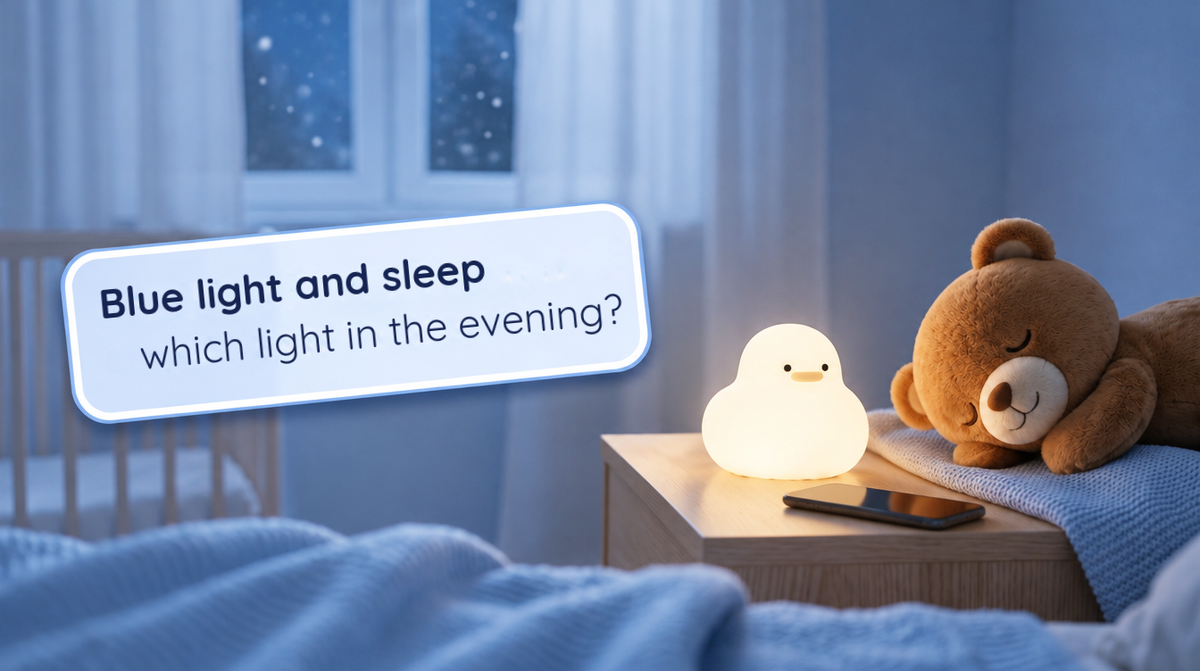
Blue light from screens and white LEDs holds back melatonin in the evening and can delay falling asleep. Anses, the French health safety agency, advises limiting it before bed and during the night, especially for children, who are more sensitive. The simplest approach: switch screens off early and light the bedroom in warm white, amber or red, at the lowest setting.
The phone checked in bed, the LED ceiling light switched on for a bottle, the tablet for the evening cartoon: blue light is everywhere in our evenings. It sends the brain a daytime signal just as it is getting ready to sleep.
The good news is that you can keep some light at night by choosing the right kind. Warm colours, with no cool white, are found on lights you can put down wherever you like, such as our portable and rechargeable night lights.
What is blue light?
Blue light is the blue part of visible light. The sun gives off a lot of it, which helps us stay awake during the day. In the evening, it comes mainly from screens and white LED lighting, which contain a large share of it.
Not all LEDs are the same. A "cool white" bulb is rich in blue, a "warm white" bulb much less so. For the home, Anses recommends warm white lighting with a colour temperature below 3,000 K.
- Rich in blue: phone, tablet, computer and TV screens, cool white LEDs, "daylight" ceiling lights.
- Low in blue: warm white bulbs, amber light, red light.
What blue light does to melatonin
Blue light holds back the production of melatonin, the hormone the body makes in the evening to prepare for sleep. Less melatonin can mean falling asleep later and a body clock that drifts.
The mechanism works through the eye. A study by a team from Inserm, the French national health research institute, in Lyon, published in the Journal of Pineal Research and reported by the French medical reference site Vidal in 2024, shows that in young adults this drop in melatonin goes through melanopsin, a photoreceptor in the retina.
Anses sums up the issue like this: exposure to light rich in blue in the evening or at night, even at a very low level, disrupts biological rhythms, and therefore sleep.
This article gives general pointers on light and sleep and is not a substitute for medical advice. A night light or a bulb does not treat insomnia or night waking. If your sleep or your child's sleep worries you, talk to your GP or your child's doctor.
What the studies say, and what they don't
The studies agree on one point: in the evening, light rich in blue holds back melatonin. They are far more cautious about the products sold to protect you from it.
Colour isn't everything
Intensity, duration and timing matter too. A warm but very bright light, left on for a long time just before bed, is still a bright light. The right habit fits in three words: warm, dim, short.
Filters and glasses: no proven benefit
According to Anses, there is no proof to date that blue light filters and glasses help protect sleep rhythms. They are no substitute for the simplest step: putting the screen down.
Red light is not a sleeping pill
Red light has the advantage of containing almost no blue. But a 2022 article on the French science site Techno-Science, which reviews the available studies, describes the evidence that it improves sleep as "anecdotal and unconvincing". It does not make you sleepy: it simply avoids adding blue at night.
When should you switch off screens?
Anses recommends limiting screen light before bed and during the night, without setting a precise time. Réseau Morphée, a French health network dedicated to sleep disorders, advises in a 2022 article by the Caf, the French family allowance office, that screens should ideally be banned in the two hours before falling asleep.
Two hours is an ideal, not always realistic on a school night. What matters is the trend: the earlier the screen goes off, the more room the evening leaves for calm. A story read under warm light, a bath or a song fill that time very well, and our article on the baby bedtime routine suggests a simple sequence.
Evening screens: what really works
The first step is to put the screen down and leave it out of the bedroom. When that isn't possible, three settings reduce the light you receive, without removing it.
The screen out of the bedroom
A phone charging in the hallway doesn't light up at 2 am for a notification. This is also Réseau Morphée's advice in the Caf article.
Brightness at its lowest
A screen at full brightness in a dark room is dazzling. Turning the brightness down reduces the amount of light you receive, whatever its colour.
Night mode, as an extra
It turns the screen yellower in the evening. It is a small plus, nothing more: Anses has not taken a position on night mode, and considers the effect of filtering lenses, glasses and screens on sleep rhythms unproven.
Distance and a lit room
The TV in the living room, at a distance, with a warm lamp on, rather than the tablet a few centimetres from the eyes in bed.
Bedroom lights at night, one by one
Blue light doesn't only come from screens. At night, it is often the ceiling light switched on for a bottle, a nappy change or a child calling out that brings the most. The table below goes through the lights in a bedroom, from the richest in blue to the warmest.
| Bedroom light | Rich in blue? | What to do at night | In our shop |
|---|---|---|---|
| Screen (phone, tablet, TV) | Yes | Out of the bedroom, otherwise brightness at its lowest and night mode on | Nothing to buy: switch it off |
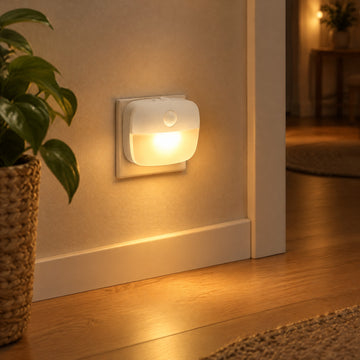
| Cool white LED ceiling light | Yes | Keep it for the daytime and emergencies, not for night-time care | A motion sensor night light comes on instead |
| Multicolour night light set to blue or white | Yes | Choose an amber or orange shade in the evening | Adult LED Night Light, set to amber |
| Warm white lamp or night light | A little | Bedtime story, bottle, nappy change, at low intensity | LED Duck Night Light for Babies, Candle Night Light, Portable Adult Night Light |
| Amber night light | Very little | Seeing without dazzling: skin, bottle, gentle reading | Red and Amber Portable Night Light, Amber version |
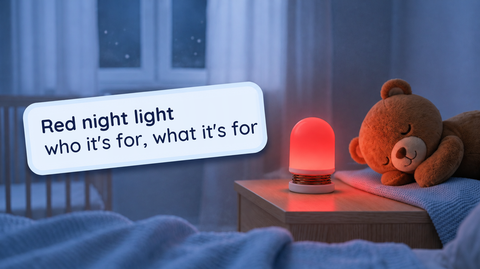
| Red night light | Almost none | Quick tasks in the middle of the night, at the lowest setting | Red and Amber Portable Night Light, Red version |
| Complete darkness | No | As dark as possible, if your child accepts it | A timer switches the night light off once your child is asleep |

Night-time care with a baby, feeds, nappy changes or a quick check, and the choice between red and amber depending on the moment are covered in our guide to the red night light. To find out whether to leave it on until morning, see our article on keeping a night light on all night.
Babies, children and blue light
Children are more sensitive to blue light than adults. Anses describes them as a particularly sensitive group, because their eyes do not fully filter blue light, and recommends limiting their exposure to screens before bed and at night in particular.
A study from the University of Colorado, published in 2022 in the Journal of Pineal Research, points the same way. In children aged 3 to 5, one hour of light before bed, even between 5 and 40 lux, lowered melatonin by 78% on average. A light that seems "dim" to an adult is therefore not necessarily neutral for a young child.
No screens at bedtime
The cartoon is watched early, in the living room. Bedtime happens without screens.
A story in warm light
A warm white lamp or night light for reading, then turn it down.
No ceiling light at night
For a bottle or a nappy change, a warm or red night light at its lowest is enough.
A timer
The night light switches itself off once your child is asleep.
And if your child asks for light because they are afraid of the dark, a dim warm glow they accept is better than a dark room they dread. Our article on fear of the dark in children offers ideas for this age.
Our selection, sorted by colour
We sell night lights, so let's be honest: none of them makes anyone sleep. These were chosen because they light the night without cool white, from red to warm white. Check the age on each product page: some are made for a baby's room, others are for adults only.
Red and amber, with no white light at all
 Red and amber Portable Rechargeable Night Light with Red and Amber Light Red or amber, with no white light at all, 3 brightness levels, switches on with a press on the dome. For adult use, keep out of reach of children. £30.90 See the night light
Warm white, for a baby's room
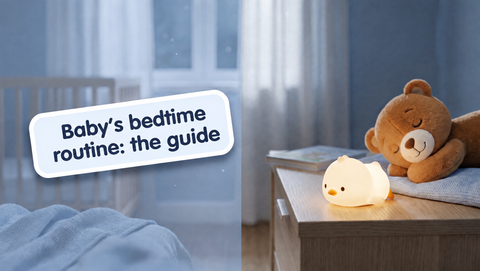
 Warm white LED Duck Night Light for Babies Warm white light with touch-adjustable brightness, 15-minute timer, BPA-free silicone, designed for night-time bottles and nappy changes. £26.90 See the night light
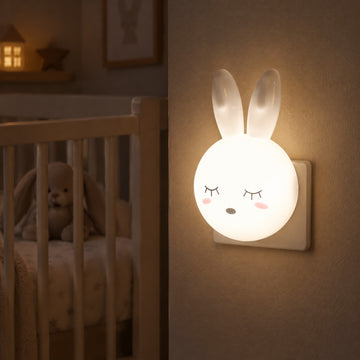
 Instead of the ceiling light Portable Bunny Motion Sensor Night Light Warm white light that switches on by itself as you pass and turns off after 25 seconds, to hang near the cot or changing table. £26.90 See the night light
 For the bedtime story Candle Night Light Flameless silicone candle, 2 touch-controlled light levels, 30-minute timer and 6 hours of battery life. £28.90 See the night light
Other warm-light night lights, animal-shaped or more understated, are gathered in our baby night lights collection.
For adults: warm white, or multicolour set to amber
 Warm white Portable Adult Night Light Warm white light with adjustable brightness, timer from 1 to 90 min, light and rechargeable, for getting up at night without turning on the ceiling light. £33.90 See the night light
 Multicolour, set to amber Adult LED Night Light A choice of colours including a soft amber, 6 brightness levels, remote control and 30 or 60 min timer. In the evening, stick to amber rather than blue or white. £32.90 See the night light
Other bedside lights designed for grown-ups are grouped in our adult night lights.
FAQ: blue light and sleep
Does blue light stop you from sleeping?
Blue light does not stop you from sleeping on its own, but in the evening it holds back melatonin, the hormone that prepares the body for sleep, and can delay falling asleep. Anses notes that even very low exposure to light rich in blue in the evening or at night disrupts biological rhythms. This is not medical advice.
Is night mode on screens enough?
Night mode reduces the share of blue from the screen, but nothing shows that it is enough to protect sleep. Anses has not taken a position on this setting and considers the effect of filtering lenses, glasses and screens on biological rhythms unproven. Lowering the brightness, moving the screen away and switching it off early remain the simple steps.
Do blue light glasses help you sleep?
Blue light glasses have not been shown to help with sleep. According to Anses, there is no proof to date that glasses and filters help protect biological rhythms. Putting the screen down before bed is a safer bet than relying on filtering lenses.
What light should you choose for a night light?
A night light works best in warm white, amber or red, at its lowest intensity and placed away from the bed. These shades contain little or no blue. For the home, Anses recommends warm white lighting with a colour temperature below 3,000 K.
What time should you switch off screens?
In a 2022 article by the Caf, the French family allowance office, Réseau Morphée advises ideally banning screens in the two hours before falling asleep and keeping them out of the bedroom. Anses does not set a time but recommends limiting screens before bed, especially for children.
Warm light for your nights
Red, amber or warm white: find the night light that lights the night without cool white.
DISCOVER OUR NIGHT LIGHTS