Night Light On All Night: What Sleep Science Says
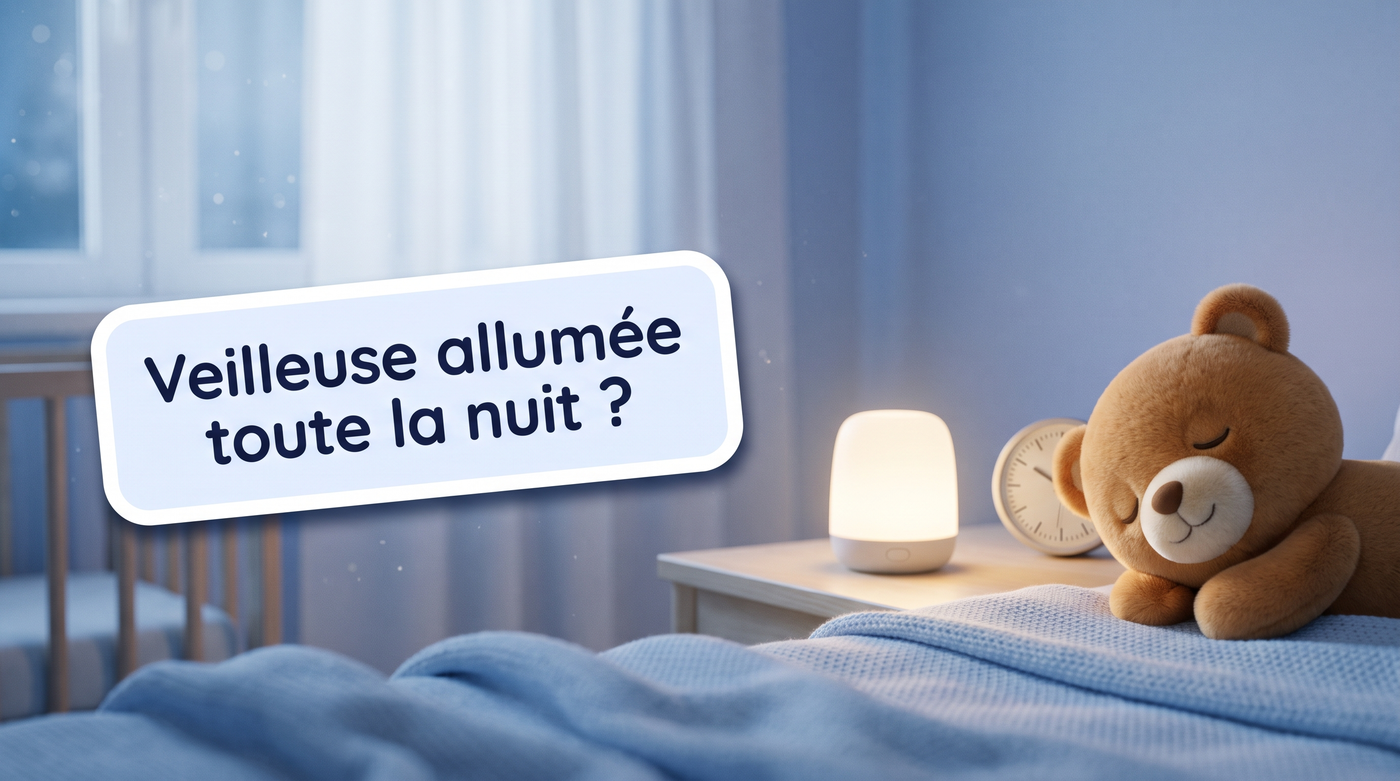
A night light left on all night isn't a problem as long as it stays dim and warm in tone, under 40 lux and above 580 nanometres. Under 2, darkness is still the ideal and the night light is mainly there for the parent. Between 2 and 5, it becomes a real source of reassurance. After 5, a timer stops it turning into a habit.
The question always comes up at the same moment, around 10pm, when the house is finally quiet and the little light in the bedroom is still on. Should you switch it off? Leaving a night light on all night worries a lot of parents, often because of what they've read about light and sleep. The answer comes down to two settings, colour and brightness, plus a third that's often forgotten: your child's age.
This article sorts out what is established, what is still debated, and what is mostly down to family habit. You'll find practical guidance for choosing, adjusting and positioning your night light.
Why leave a night light on all night?
In the vast majority of cases, a night light isn't switched on to light the room. It's switched on to reassure, and that role matters most when your child is falling asleep and when they wake in the night.
Fear of the dark in children
Fear of the dark usually appears at around 2 or 3 years old, when the imagination has developed enough to fill a dark room. It isn't a whim. The child doesn't fear the absence of light, they fear what they can no longer check.
A steady glow changes that. It lets your child open their eyes at 2am, recognise their wardrobe and their rug, then go back to sleep on their own without calling out. That's exactly what a well-adjusted sleep light provides: the chance to check, without waking the brain up.
The need for visual landmarks at night
The second use is purely practical, and it concerns the adult at least as much as the child. The 3am bottle, the nappy change, the glass of water, the trip to the loo: all of these are usually handled by switching on the ceiling light or a phone, which shines a bright light into everyone's eyes.
A night light that is already on avoids that burst of light. You can see what you're doing, your child stays half asleep, and nobody ends up lying awake staring at the ceiling for thirty minutes. That's also why a night light has its place in a nursery from the very first weeks, even though a newborn has no fear of the dark yet.
A night light is useful from the very first nights because it's the parent who uses it. It passes into the child's hands much later: at 18 months for a one-piece soft silicone model, at 3 years as soon as there's a remote control, a button battery, glass or a small part.
How a night light affects sleep at each age
The same object doesn't play the same role at 6 months, 3 years and 7 years. Here's how its use changes, and what that means for you in practice.
Under 2: darkness is still best
In very young children, the body clock is still being set, and a clear alternation between day and night is part of that process. A dark room therefore remains the ideal for the whole night.
That doesn't mean giving up on light altogether. It means the night light is a practical tool, switched on for night-time care and then dimmed or turned off, rather than a permanent mood light. An adjustable baby night light, chosen from our soft silicone models designed for little ones, allows both uses: very low by default, a little brighter for a nappy change.
From 2 to 5: the night light as a sleep ally
This is when a night light is most helpful. Fear of the dark has set in, your child moves around on their own, and they're starting to put words to what worries them. A soft, steady glow cuts down on calls in the night and shortens the bedtime routine.
At this age, what matters is that the light is steady. A model that constantly cycles through colours or flickers draws attention instead of letting it go. The night lights designed for children of this age tend to favour a fixed colour over animation.
After 5: avoiding dependence
After 5, most children no longer need a light to get back to sleep. Many keep it anyway, simply because it has always been there. That isn't a problem in itself, but it's a good time to cut back gradually, especially if your child is going on a school residential trip or sleeping over at a friend's.
| Age | Role of the night light | Recommended setting |
|---|---|---|
| 0 to 2 years | A tool for the parent, night-time care | Very low, warm tone, outside the cot |
| 2 to 5 years | Reassurance, independence when they wake | Steady, dim glow, left on continuously |
| 5 years and over | Comfort, often a habit | Timer, brightness gradually reduced |
Which night light colour won't disrupt sleep?
This is the most decisive factor, even more than brightness. The retina contains cells that aren't used for seeing but for informing the body clock, and they don't react the same way to every colour.
Lights to avoid
Cool white and blue are the tones that have the strongest effect on this system. They're also the colours of screens, modern ceiling lights and many budget night lights sold as daylight.
Intense green and so-called neutral white cause the same problem to a lesser degree. If the room looks properly lit when the night light is the only thing on, the colour is probably as much to blame as the power.
Recommended lights
Wavelengths above 580 nanometres, in other words amber, orange and red, have the least effect on this system. That's why the best-designed children's night lights move away from white in favour of a warm glow, close to candlelight.
For frequent use at night, particularly for bottles and nappy changes in the early months, a proper red light is the most restrained choice. It gives enough light to move around, and little enough not to wake anyone.
 An example Red Round Plug-In Night Light Warm red glow, dusk sensor that switches it on by itself at nightfall, 6.2 cm in diameter, plugs straight into the socket. View the night light
How many lux should a night light be?
The benchmark to remember is simple: under 40 lux, measured at eye level, in bed. Above that, the light starts to affect melatonin production. Below it, its influence becomes marginal.
Few people own a light meter, but the visual test is reliable. If you can clearly make out the colour of the walls and could read a few lines of a book, it's too bright. If you can only make out the outlines of the furniture, you're in the right range.
Two details make all the difference. Distance first, because brightness drops very quickly as the source moves away from the face. Then direction, because a light pointed at the wall rather than the bed automatically reduces how much reaches the eyes.
A well-adjusted night light isn't something you admire; you barely notice it.
Not every sleep problem can be solved with a lamp. If night wakings are frequent, or come with inconsolable crying or marked tiredness during the day, talk to your GP or paediatrician. A night light is a comfort object, not a treatment.
On all night or on a timer: which to choose?
Both approaches have their merits, and the right choice depends mainly on what happens in your home between midnight and 5am.
The advantages of leaving it on
A child who wakes finds exactly the room they left. Nothing has changed, there's nothing to work out, and they go back to sleep. It's the most effective option for children who call out several times a night, and for those who get up on their own.
- No waking caused by the light switching off
- A steady landmark if they wake at 3am
- Safer trips around the room at night
- Continuous energy use, low but real
- A habit that takes longer to break later
- Needs a really low setting
The advantages of a timer
A timer keeps your child company while they fall asleep, then returns the room to darkness, which is still the best set-up for the second half of the night. It suits children who find it hard to fall asleep but then sleep straight through.
It's also the most flexible solution when you want to cut back gradually without removing the night light all at once. Thirty minutes is usually enough to cover the time it takes to fall asleep.
 The model mentioned Portable Panda Night Light 30-minute timer, adjustable brightness, BPA-free silicone and USB charging with no batteries, measuring 9.4 x 10.9 cm. View the night light
Where to put the night light in the bedroom
Placement fixes a lot of setting mistakes. A night light placed too high or facing the bed shines straight into the eyes, even at low power. Placed low and turned towards a pale wall, the same lamp becomes an indirect glow that is much easier to live with.
So aim for a low position, out of your child's line of sight when lying down. The floor along a skirting board, a low shelf or a wall socket works better than a bedside table at pillow height. The idea is for your child to see the room lit up, not the light source itself.
Finally, think about the route. If your child gets up in the night, the light should cover the way from the bed to the door, not just the corner by the bed. Models that plug straight into a socket do this job well, at skirting-board height, with no trailing cable.
A night light should never go in the bed, against a cot bumper or under a blanket. The cable must be kept out of reach. Check that the model is CE and RoHS compliant, and that it doesn't get hot after several hours switched on.
How to gradually wean your child off the night light
Taking the night light away overnight rarely works, and often costs you several restless nights. A transition over a few weeks goes much more smoothly, and your child keeps the feeling that they're in charge.
Lower the brightness gradually
Turn it down one notch every five to seven days, never in the middle of a difficult week. Each step is small enough to go unnoticed, and after a month the light is little more than a symbolic presence.
Switch on the timer
Once the brightness is low, move from leaving it on all night to automatic switch-off after your child has fallen asleep. Explain it to them beforehand, rather than letting them discover the change at 2am.
Offer a substitute
A portable night light they switch on themselves for a few minutes, a comforter, a door left ajar onto the landing. What reassures them isn't the light as such, it's keeping a way to act.
If a step doesn't go well, simply go back to the previous one for a week. Successful weaning isn't fast weaning, and a temporary setback around a house move or the start of a school year is perfectly normal.
FAQ
Is it dangerous to leave a night light on all night?
No, as long as it stays dim and warm in tone. A CE and RoHS compliant night light, placed out of the line of sight and set to its lowest level, carries no known risk. What causes problems is a bright or bluish light pointed at the face for eight hours.
Which night light for a baby under 1?
A one-piece soft silicone model, with no button battery or small parts, and a warm, adjustable light. It goes outside the cot, never inside it. The product pages spell out the rule: in the room from birth, handled by the child from 18 months.
Does a night light disrupt melatonin production?
A bright, cool light can delay melatonin production. An amber or red night light kept below 40 lux at eye level stays well below the levels concerned. So colour and brightness matter far more than the mere presence of a light.
How many lux for a bedroom night light?
Aim for under 40 lux measured at eye level, in bed. In practice, that's a glow that lets you make out the outline of a piece of furniture without being able to read. If you can clearly see the colours in the room, the night light is set too bright.
From what age can a child handle their night light on their own?
It depends on the model. One-piece soft silicone night lights can be handled from 18 months. As soon as there's a remote control, a button battery, glass or a small part, the product page says 3 years. Either way, it can light the room from birth.
Looking to bring a little calm to the bedroom?
Nearly 400 models, CE and RoHS compliant, and checked before dispatch.
VISIT THE SHOP