Night Terrors: Ages, Causes and What to Do During an Episode
A night terror is an incomplete awakening early in the night, during deep sleep: the child screams, thrashes about, has their eyes open and seems awake but is asleep, and remembers nothing the next day. The episode lasts a few minutes. You should not wake the child, just stay close. Night terrors mainly affect children, sometimes adults.
It's 11 pm, you have only just gone to bed, and a scream rings through the house. In the bedroom, your child is sitting up in bed, eyes wide open, sweating, and doesn't recognise you. They push you away when you try to pick them up. These are the signs of a night terror, and it is far more frightening for you than for them.
This guide brings together what public health sources say (the French public health portal Santé.fr, the French sleep network Réseau Morphée, the MSD Manual): how to recognise a night terror, at what age, what to do during an episode and when to see a doctor. We add what we know well, the bedroom at night and its lighting, with our gentle-light kids' night lights.
This article gives general guidance drawn from public health sources; it does not replace medical advice. A night light neither prevents nor treats night terrors. If your child's sleep or your own worries you, talk to your GP or your child's doctor.
Night terrors: definition
A night terror is an incomplete awakening that happens during deep sleep, early in the night. According to the Réseau Morphée (on Santé.fr), the child cries or screams, has their eyes open, mumbles incomprehensible words and may struggle if you try to calm them.
The MSD Manual adds what parents often see: the child looks terrified, their heart beats fast, they breathe quickly and sweat. They don't seem to see you, and if they talk, they don't answer your questions.
When in the night
A night terror tends to come early in the night, less than three hours after falling asleep, according to Santé.fr. It arises from deep slow-wave sleep, the stage specialists call N3 (MSD Manual, professional version).
What happens next
After a few minutes, the child falls back asleep on their own and has no memory of the episode the next morning. Santé.fr points out that night terrors express no anxiety and are not nightmares.
Night terror or nightmare? How to tell them apart
A night terror comes early in the night during deep sleep: the child is asleep and doesn't remember it. A nightmare comes more often in the second part of the night during REM sleep: the child really wakes up, recognises you and can tell you about the dream. What you should do is almost the opposite.
| Sign | Night terror | Nightmare |
|---|---|---|
| Time of night | Early in the night, less than 3 hours after falling asleep | Usually the second part of the night |
| Sleep stage | Deep slow-wave sleep | REM sleep |
| What you see | Eyes open, screaming, thrashing, sweating, doesn't recognise you | Wakes up in tears and recognises you |
| Is the child awake? | No, they are asleep | Yes, they are awake |
| Memory the next day | None | Usually, they can tell you about it |
| What to do | Don't wake them, stay close, don't mention it the next day | Go to them, comfort them with a cuddle, talk about it the next day in simple words |
Sources: Santé.fr, "Troubles du sommeil chez l'enfant" (2026, in French); MSD Manual, "Sleep Problems in Children" (reviewed 2025).

Nightmares are normal from time to time. When the child really wakes up and is afraid of the dark when going back to sleep, our article on fear of the dark in children covers that other situation.
At what age do night terrors happen?
Night terrors mainly affect children, but the sources don't all give the same age range. The Réseau Morphée mainly mentions children under 2 and school-age children, the MSD Manual most often between 3 and 8. Rather than inventing an average, here is what each one says.
| Source | Date | What it says about age |
|---|---|---|
| Réseau Morphée, "Les parasomnies" (Santé.fr) | 2021 | Mainly children under 2 and school-age children |
| MSD Manual, consumer version | Reviewed 2025 | Most often between 3 and 8 years old |
| Santé.fr, "Troubles du sommeil chez l'enfant" | 2026 | Common in children, no specific age |
| MSD Manual, professional version | 2026 | More common in children, also possible in adults |
The MSD Manual states that night terrors usually stop without treatment, even though isolated episodes may come back for many years.
Night terrors in babies and young children
A night terror in a baby looks like one in an older child: sudden crying or screaming early in the night, eyes open, a baby you can't comfort who falls back asleep on their own. The Réseau Morphée lists children under 2 among those most affected.
In a baby, crying at night also has many other causes: hunger, waking between two sleep cycles, discomfort. Our article on why babies wake up at night goes through these more ordinary wake-ups.
How do you calm a night terror in a baby?
A night terror can't really be calmed; it passes. The advice is the same at any age: don't wake the baby, stay close so they don't bump themselves, and wait for them to fall back asleep. If anything seems unusual (fever, difficulty breathing, behaviour that isn't like them), call your doctor.
Night terrors in adults: causes and signs
Night terrors also exist in adults, even though they are more common in children. According to the MSD Manual (professional version), they arise from the same deep slow-wave sleep and, in adults, can be associated with psychological problems or alcohol use disorder.
The signs are similar: a sudden scream, thrashing, intense fear, then falling back asleep with no memory of it. The same manual says episodes can lead to sleepwalking, which is why a bedroom with no obstacles or dangerous objects near the bed makes sense.
For adults, the MSD Manual mentions psychotherapy or medication, which necessarily goes through a doctor. Night terrors that appear or come back in adulthood are worth discussing with your GP.
What to do during an episode, step by step
During a night terror, don't wake the child or try to calm them at all costs: stay close for their safety, keep the light low and wait for them to fall back asleep, which takes a few minutes. The next day, don't mention it.
Don't wake them
Santé.fr and the MSD Manual both say so: waking the child may unsettle them and frighten them even more. They are asleep, even with their eyes open.
Stay close, for their safety
They may struggle if you try to calm them. There's no need to hold them: move away anything that could hurt them, check they can't fall out of bed, and stay there.
Keep the light low
To see what is happening, a small light placed away from the bed is enough. Suddenly switching on the ceiling light goes against the first rule: don't wake them.
Wait for them to fall back asleep
The episode lasts a few minutes, then the child sinks back into deep sleep on their own. You can then tuck the covers back and switch off the light.
The next day, don't mention it
They don't remember it. Santé.fr advises not to talk to them about it, unlike a nightmare, which you talk about in simple words.
Light during an episode
During an episode, you need to see the child, the bed and what is around it, without lighting up the whole room. A red or amber night light, placed on the chest of drawers and set to its lowest level, lets you see without white light. It has no effect on the night terror: it is there for the parent, not the child. Our portable night light with red and amber light switches on with a single press, and our guide to the red night light explains when to choose red or amber.
Causes: what the sources say
The health sources consulted don't give a single cause for night terrors in children. They describe them as an incomplete awakening during deep sleep, and stress the importance of sleep rhythm: regular sleep times and enough sleep, according to the Réseau Morphée.
- Disrupted sleep: the MSD Manual advises having a child who thrashes about and snores at night assessed for sleep apnoea.
- In adults: the MSD Manual lists psychological problems or alcohol use disorder among the possible associations.
Preventing episodes: routine, bedtime and bedroom
According to the Réseau Morphée, no particular treatment is needed for children: prevention relies on regular sleep times and enough sleep. At home, that means a fixed bedtime, a calm evening and a safe bedroom.
A fixed bedtime
An evening ritual always in the same order (bath, pyjamas, story, soft light) helps keep to regular times. Our guide to the bedtime routine suggests a step-by-step ritual, from babies to older children.
A safe bedroom at night
Episodes can lead to sleepwalking, the MSD Manual reminds us. Nothing dangerous near the bed, a clear floor, a stair gate at the top of the stairs if the child sleeps upstairs: these are simple precautions. As for light, a faint, warm glow placed away from the bed is enough; our article on leaving a night light on all night sums up what sleep science says.
Our selection for seeing at night without dazzling
None of these night lights has any effect on night terrors. They serve what we have just covered: a low light for bedtime, enough to see during an episode without switching on the ceiling light, and a lit hallway when you get up.
 During an episode Portable Rechargeable Night Light with Red and Amber Light Red or amber, with no white light at all, 3 brightness levels, switches on with a press on the dome. For adult use, to be placed out of children's reach. £30.90 View the night light
 Baby's room LED Duck Night Light for Babies Warm light with touch-adjustable brightness, 15 min timer, BPA-free silicone, USB rechargeable. £26.90 View the night light
 Bedtime ritual Candle Night Light Flameless silicone candle, 2 touch-controlled brightness levels, 30 min timer and 6 h battery life. £28.90 View the night light
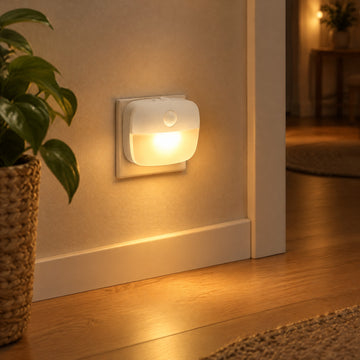
 In the hallway LED Motion Sensor Hallway Night Light Lights up as you walk past (120° detection up to 5 m), switches off after 20 seconds, magnetic mounting with no drilling. £14.90 View the night light
More soft, cordless lights to carry from the bedroom to the hallway are gathered in our portable and rechargeable night lights, the models designed for little ones in our baby night light collection, and bedside lights for grown-ups in our night lights for adults.
Homeopathy and "miracle cures": what the sources say
None of the health sources consulted offers a miracle cure for night terrors in children. The Réseau Morphée states that no particular treatment is needed, and the MSD Manual that night terrors usually stop without treatment.
On homeopathy, the French National Authority for Health (Haute Autorité de santé) issued an opinion on 28 June 2019 that homeopathic medicines have not scientifically shown sufficient effectiveness to justify their reimbursement. This opinion is general: it does not specifically concern night terrors.
Before giving your child anything for their sleep, talk to your GP or your child's doctor.
When should you see a doctor?
A one-off night terror doesn't call for a doctor's appointment. It is worth talking to a doctor when episodes keep coming back, when the child snores and thrashes about at night, when their days suffer, or when episodes continue into adolescence or adulthood.
- Your child snores and thrashes about at night: the MSD Manual says the doctor may suggest checking for sleep apnoea.
- Sleep problems last more than a week: this is the threshold for seeing a doctor given by Vidal, a French medical reference, for sleep problems in children.
- Their days are affected: tiredness, difficulties at school. The MSD Manual (professional version) then considers medical treatment.
- Episodes continue into adolescence or adulthood, in a severe form: the MSD Manual says treatment may then be needed.
- It is a matter of intense, repeated nightmares, not night terrors: Santé.fr advises talking to your child's doctor, as they can reflect deeper anxiety.
And in any case, if something worries you, your doctor is still the right person to call.
FAQ: your questions about night terrors
At what age do night terrors happen?
Night terrors mainly affect children. The Réseau Morphée mainly mentions children under 2 and school-age children, the MSD Manual most often between 3 and 8 years old. They usually stop without treatment, and more rarely affect adults.
What is the difference between a nightmare and a night terror?
A night terror happens early in the night, during deep sleep: the child screams but is asleep, and doesn't remember it. A nightmare happens more often towards the end of the night, during REM sleep: the child wakes up, recognises their parents and can tell them about the dream.
Should you wake a child having a night terror?
No, you should not wake a child during a night terror: Santé.fr and the MSD Manual explain that it may unsettle them and frighten them even more. Stay close for their safety, keep the light low, and wait for them to fall back asleep on their own, after a few minutes.
How do you calm a night terror in a baby?
A night terror in a baby can't really be calmed; it passes within a few minutes. Don't wake the baby, stay close so they don't bump themselves, keep the light low, then let them fall back asleep. If there is a fever or any unusual sign, call your doctor.
Night terrors every night: what should you do?
Night terrors almost every night are a reason to talk to a doctor: Vidal, a French medical reference, advises seeing a doctor when a child's sleep problems last more than a week. In the meantime, the Réseau Morphée recommends regular bedtimes and enough sleep.
Can adults have night terrors?
Yes, night terrors exist in adults, even though they are more common in children. According to the MSD Manual, in adults they can be associated with psychological problems or alcohol use disorder, and can lead to sleepwalking. An adult affected should talk to their doctor.
Sources
- Santé.fr (French public health portal), "Troubles du sommeil chez l'enfant", published on 13 August 2026, in French: sante.fr
- Réseau Morphée on Santé.fr, "Les parasomnies", published on 29 April 2021, in French: sante.fr
- MSD Manual, consumer version, "Sleep Problems in Children", reviewed in May 2025: msdmanuals.com
- MSD Manual, professional version, "Parasomnias", reviewed in July 2026: msdmanuals.com
- Vidal, "Cauchemars et terreurs nocturnes", updated on 7 October 2021, in French: vidal.fr
- Haute Autorité de santé (French National Authority for Health), "Médicaments homéopathiques : une efficacité insuffisante pour être proposés au remboursement", 28 June 2019, in French: has-sante.fr
A soft light for seeing at night without dazzling
Red, amber or warm light: enough to see at night without waking the whole house.
DISCOVER OUR NIGHT LIGHTS