Fear of the Dark in Children: What Age and How to Help
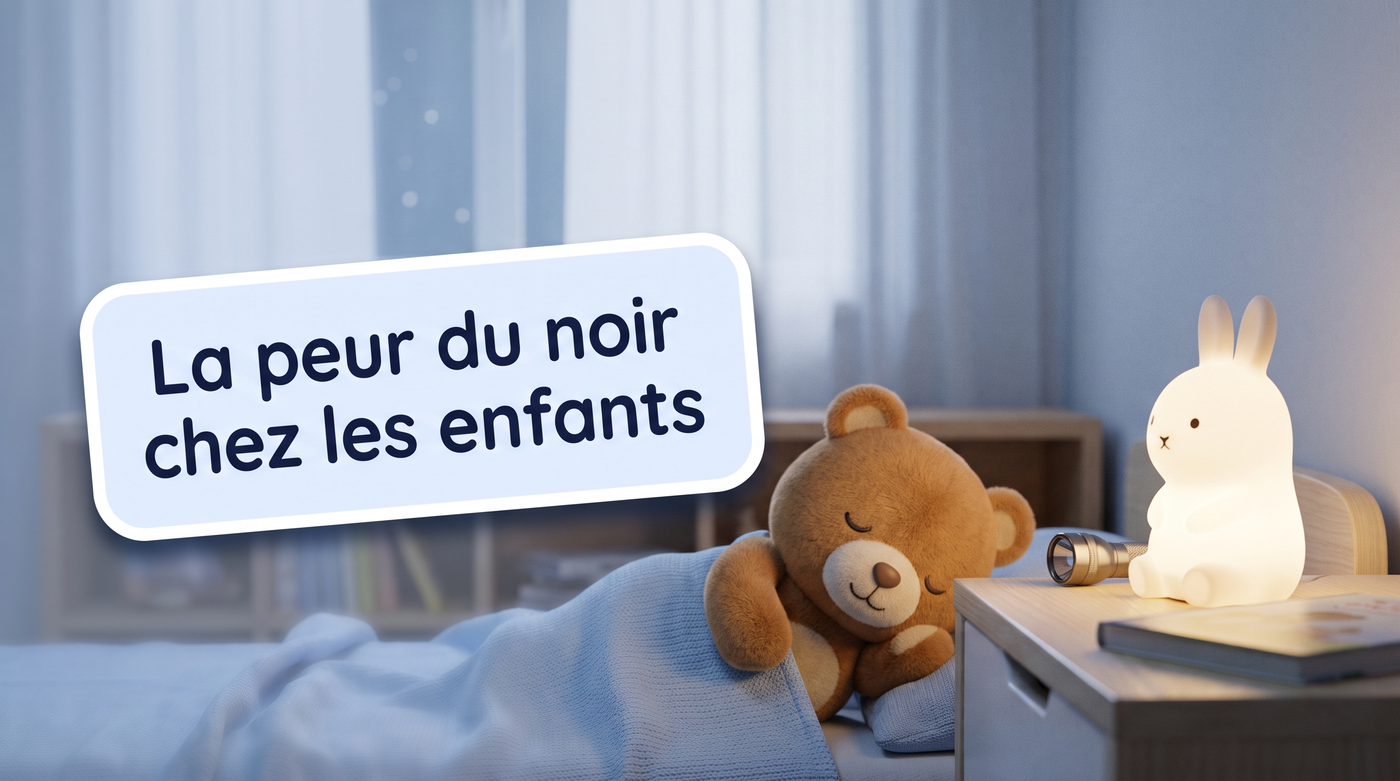
Fear of the dark in children usually appears at around 18 months, peaks between 2 and 4, then fades on its own between 6 and 8. It isn't the darkness itself that worries them, it's what their imagination projects into it. Your role comes down to three things: acknowledge the fear, keep the same evening routine every night, and leave a dim light on. If the fear is still very intense after the age of 8 to 10, talk to a health professional.
It's 9.40pm, the house is finally quiet, and a small voice calls out from the bedroom. The landing light was enough last week; tonight it isn't. Before looking for a solution, it helps to know what you're dealing with: not a tantrum, not a delay, and not a sign that something has gone wrong at home. It's a stage, with an age when it starts, a peak and a way out.
At what age are children afraid of the dark?
Fear of the dark usually appears at around 18 months, peaks between 2 and 4 years old, then eases as the child learns to separate what's real from what's imagined, most often between 6 and 8. There are big differences from one child to another, and a child who has never been afraid of the dark is no stronger or more mature than any other.
| Age | What's happening | What helps most |
|---|---|---|
| Around 18 months | Imagination is waking up, separation anxiety dominates | A predictable presence, a comforter, a dim light |
| 2 to 4 years | The fear peaks, shadows take on shapes | Acknowledging the fear, the same routine every night |
| 4 to 6 years | The child puts words to what they fear | Getting them to talk about it, playing with the dark during the day |
| 6 to 8 years | Real and imaginary separate, the fear fades | Letting the child decide when to do without the light |
| After 8 | A fear that is still as intense is out of the ordinary | Talking to your GP or paediatrician |
From 18 months: imagination wakes up
At around 18 months, children begin to tell the real from the imaginary, but only very imperfectly. It's precisely this blurred boundary that opens the door to the first night-time fears.
At this age, the fear is often mixed with separation anxiety. Once the light goes off, the child suddenly loses all their visual landmarks: their comforter, the outline of the cot, the wall they know by heart. Everything disappears, and you disappear with it. It isn't the night they dread, it's finding themselves alone in a room whose edges they can no longer see.
Between 2 and 4: the peak of fear of the dark
This is the most intense period, and the one that comes up most often, both with health professionals and in conversations between parents. Imagination develops very quickly, reasoning much less so. The result: pyjamas left on a chair become a figure, a creaking radiator becomes footsteps on the landing.
At this age, explaining that nothing is hiding under the bed doesn't solve anything, because your child already believes you. Their fear doesn't come from faulty reasoning, it comes from a mental image they can't switch off. What helps is a stable environment and a reliable presence, not a demonstration.
What your child fears isn't the darkness, it's what they imagine it hides.
After 6 to 8: when should you worry?
At around 6 or 7, most children can clearly sort out what exists from what comes from their own head. The fear then fades by itself, often without you having done anything in particular. Some keep a night light for longer, for comfort, and that's absolutely fine.
It's a different question if, after the age of 8 to 10, the fear is as intense as it was at 3: nights disrupted every time, refusing to sleep alone, panic as soon as the light goes off. This is no longer the ordinary fear that comes with development, and medical advice is then worthwhile.
Fear of the dark often returns after a calm spell, and it usually follows a specific event: a house move, the start of the school year, a new baby, a separation. Night-time fear is often the translation of a day that has unsettled the child.
Why are children afraid of the dark?
The role of imagination and cognitive development
In the dark, the brain keeps searching for information. As it receives almost none, it fills the gaps with whatever it has in stock: a story heard at school, an image glimpsed on a screen, an emotion from the day. It's a normal mechanism, and it works in adults too, except that you know how to put the image back where it belongs.
A 3-year-old doesn't have that tool yet. So their fear isn't irrational: it's logical for their age. That's also why bedtime stories, including ones with wolves in them, are useful: they name the fear, keep it at a distance and end well.
Is fear of the dark normal?
Yes. It's one of the most common fears among pre-school children, alongside fear of animals or loud noises. In the vast majority of cases it disappears on its own, with no treatment or special support.
That doesn't mean it should be left unanswered. A fear that is acknowledged settles faster than one that is ignored, and the way you respond in the evening matters more than the object of the fear itself.
Factors that make the fear worse
Four factors come up again and again when a fear of the dark takes hold or grows stronger instead of fading.
Screens late in the day
Stimulating images, sometimes unsettling without anyone noticing, feed the imagination just before bedtime.
A recent change
A house move, a new school year, a birth, a separation: whatever weighs on the day comes out at night, when there are no more distractions.
How adults react
Teasing, playing it down or forcing the child to stay in the dark makes the fear stronger, because it becomes a fear they face alone.
A bedtime with no fixed points
8pm one night, 9.30pm the next, the order of things always changing: without predictability, the child stays on alert.
How does fear of the dark show itself in children?
Behavioural signs to look out for
Many children never say "I'm afraid of the dark". They show it in other ways, often through behaviour that at first looks like resistance to bedtime.
- Refusing to go to bed, or repeatedly coming out of the bedroom
- Crying or shouting as soon as the light goes off
- The same requests every night: door open, night light, a glass of water, one more story
- Difficulty falling asleep alone, even though they drop off quickly when you're there
- Waking in the night and needing reassurance
- Tummy aches or headaches in the evening that disappear when you stay
- Irritability at the end of the day as bedtime approaches
When does fear of the dark become a problem?
Ordinary fear stays confined to the evening and gradually gives way. It becomes a concern when it starts taking up space elsewhere.
- It has lasted for several months with no improvement despite your efforts
- It disrupts sleep over the long term, for the child and the whole household
- It comes with strong physical reactions: trembling, nausea, difficulty breathing
- It spills over into the day: refusing to go into a dark room, avoiding a cellar or a hallway
- It persists after the age of 8 to 10 with the same intensity as at 3
In these situations, the right person to talk to is your GP, a paediatrician or a children's mental health professional. However thorough an article may be, it can't replace advice on a specific situation.
How can you help a child who is afraid of the dark?
The aim isn't to get rid of the fear tonight, but to make bedtime feel safe enough for it to dissolve by itself over a few weeks. Four levers work together: words, routine, light and play.
Acknowledge their feelings without playing them down
The first thing to do, and by far the most effective, is to take the fear seriously. "It's nothing", "you're a big boy/girl now" or "there's nothing in the dark" don't reassure: these phrases add shame to fear, and above all the child learns to stop telling you about it.
Three phrases that work, to adapt to your own words:
- "I understand that you're scared, we'll deal with it together."
- "Lots of children are afraid of the dark, it happens really often."
- "What exactly is scaring you? Tell me about it."
Getting them to name the fear already shrinks it. A child who manages to say "I'm scared of the coat stand's shadow" has turned a vague threat into something identifiable, and therefore manageable.
Set up reassuring bedtime routines
Predictability is the best antidote to evening anxiety. A steady routine tells your child that the evening follows a familiar path, and that there won't be any nasty surprise at the end.
Turn off screens
At least an hour before bed. It's the simplest step and often the one with the most visible effect on falling asleep.
Always the same order
Bath, pyjamas, teeth. The order you choose doesn't matter; what counts is that it doesn't change from one night to the next.
A story, sitting quietly
In the bedroom, with the light already low. The story bridges the gap between the bustle of the house and the silence of the night.
A tour of the room
Together, you put away the clothes on the chair and check whatever your child asks you to. Thirty seconds, not ten minutes.
The light, then the door
Night light on, door ajar if your child wants, and always the same goodnight phrase as you leave.
Consistency matters more than perfection. A simple routine kept up every night is better than an elaborate one followed one night in three.
Use a night light and the layout of the room
A useful night light is a discreet one: warm light, amber or orange rather than cold white, at a low level, just enough to make out the outlines of the room if they wake. Place it away from the bed and out of their direct line of sight, otherwise it becomes a fixed point of light that makes it harder to fall asleep.
- The outlines of the room stay visible when they wake at night
- No more switching on the ceiling light at 3am
- Your child has an object they are in control of
- It reassures without you having to stay in the room
- It doesn't make the fear disappear, it makes it bearable
- It doesn't replace the routine or talking things through
- It does nothing for separation anxiety
- Too bright or too cold, it delays sleep
A useful point about age: a night light has its place in the room from birth, because it's the parent who uses it during night wakings. Children handling it themselves comes much later: from 18 months for our one-piece soft silicone night lights, and from 3 years as soon as a model has a remote control, a button battery, glass or a small part.
On this point, three features really change bedtime for a child who is afraid: a timer, so the light switches off on its own without you having to get up again, a soft material with no detachable parts if your child keeps the night light close by, and a colour they choose themselves, which gives them back a little control at a moment when they have very little.
 An example Multicolour Silicone Bunny Night Light 3-hour timer for automatic switch-off, soft silicone with no detachable parts, 7 colours via touch sensor and an LED that doesn't get hot. View the night light
In the bedroom, three one-minute gestures take away a lot of material for the imagination: put away the clothes left on a chair, leave the door ajar if your child finds the sounds of the house reassuring, and put the comforter in full view rather than at the bottom of the bed.
Pretend play to tame the dark
Children get used to things more easily once they've handled them through play. The idea is to meet the darkness outside of bedtime, when nothing is at stake and you're there.
- The torch: shadow puppets on the wall, a treasure hunt with the curtains closed. The dark becomes a playground.
- A protective object: an "anti-monster" water spray, a drawing pinned up above the bed, a comforter standing guard.
- Picture books about fear of the dark: read during the day, they give your child words they can use again in the evening.
- Your own memory: telling them that you were scared too, and what helped you, is worth more than any reassuring speech.
As your child grows, the logic stays the same: hand control back to them. From around 5 or 6, models they can switch on and off themselves turn the night light into a personal tool rather than something the parents provide.
What not to do
Some reflexes, sometimes recommended by people around you, make things worse rather than better.
- Forcing your child to stay in the dark so they get used to it: exposure they endure without support increases anxiety.
- Teasing or playing it down: your child already knows there's nothing there, and it doesn't change how they feel.
- Threatening them with a scary character to get them to behave: you're feeding exactly what you're trying to calm.
- Leaving them to cry without coming: a frightened child needs to check that you always respond.
- Endless negotiating: ten trips back to the bedroom set up a power struggle just when calm is needed.
- Always sleeping with them as the only solution: it brings relief that night and makes the following ones harder.
What if fear of the dark lasts into the teenage years or adulthood?
Nyctophobia: definition and symptoms
Nyctophobia, from the Greek nyktos, night, and phobos, fear, refers to a specific phobia of darkness. It differs from ordinary fear in three ways: its intensity, its persistence and its impact on daily life.
It isn't passing discomfort but strong, hard-to-control anxiety as soon as it gets dark, even briefly: a racing heart and fast breathing, a feeling of imminent danger, avoiding any dark situation, being unable to sleep without a light, including in adulthood.
Only a professional can make that assessment. A marked fear of the dark in a 4-year-old isn't a phobia; it's how children that age normally function.
When should you see a professional?
Medical advice is worthwhile when several of these signs add up and last.
- The fear remains just as intense after the age of 8 to 10
- It comes with repeated physical symptoms: palpitations, nausea, dizziness
- It spills over into the day and limits your child's activities
- Sleep is disrupted over the long term, for your child and for the household
- You notice unusual withdrawal, aggression or regression
The support offered for specific phobias is often based on cognitive and behavioural approaches, with very gradual, supervised exposure. It's the professional who assesses the situation and chooses what's appropriate. Asking for advice commits you to nothing, and doing it early can spare you many difficult months.
FAQ: your questions about fear of the dark
Is fear of the dark hereditary?
There is no gene for fear of the dark. A general sensitivity to anxiety can be passed on, but environment matters at least as much: children watch very closely how adults react at night, and they adjust their own level of alertness to yours. In other words, if you're uneasy in the dark yourself, the way you respond to their fear will count for more than anything they've inherited.
My 3-year-old is very scared of the dark. Is that normal?
Yes. Between 2 and 4, fear of the dark is one of the most common fears, because imagination develops faster than the ability to reason with it. A 3-year-old who is very frightened isn't oversensitive or badly brought up: they're perfectly normal for their age. Acknowledge the fear, keep a steady bedtime routine, leave a dim light on. If sleep is still very disrupted for several weeks despite this, talk to your GP.
Should you leave a night light on all night?
Nothing requires it and nothing rules it out. If the night light helps your child fall asleep peacefully, it has every reason to be there, and there's no rush to take it away. Choose a dim, warm light placed out of their direct line of sight. A timer settles the question if you'd like it to switch off once they're asleep. Then let your child decide when they're ready to do without it.
At what age does fear of the dark go away?
Most often between 6 and 8, when children clearly distinguish the real from the imaginary. The decline is gradual and rarely steady: it can briefly return after a house move, the start of a school year or the arrival of a new baby, then fade again. A fear that is still just as intense after the age of 8 to 10, however, is worth discussing with a health professional.
What kind of night light is best for a child who is afraid of the dark?
A warm, dim light, amber or orange, just enough to make out the outlines of the room. Cold, bluish tones, like those from screens, delay sleep. Place the night light away from the bed and out of their direct line of sight, then lower the brightness if your child is comfortable with it: the aim is for them to see their room, not the lamp.
Looking to bring a little calm to the bedroom?
Nearly 400 models, CE and RoHS compliant, checked before dispatch. Rated 4.7 out of 5 from 564 reviews.
VISIT THE SHOP