Which Night Light for Your Maternity Stay? Criteria, Colours and Comparison
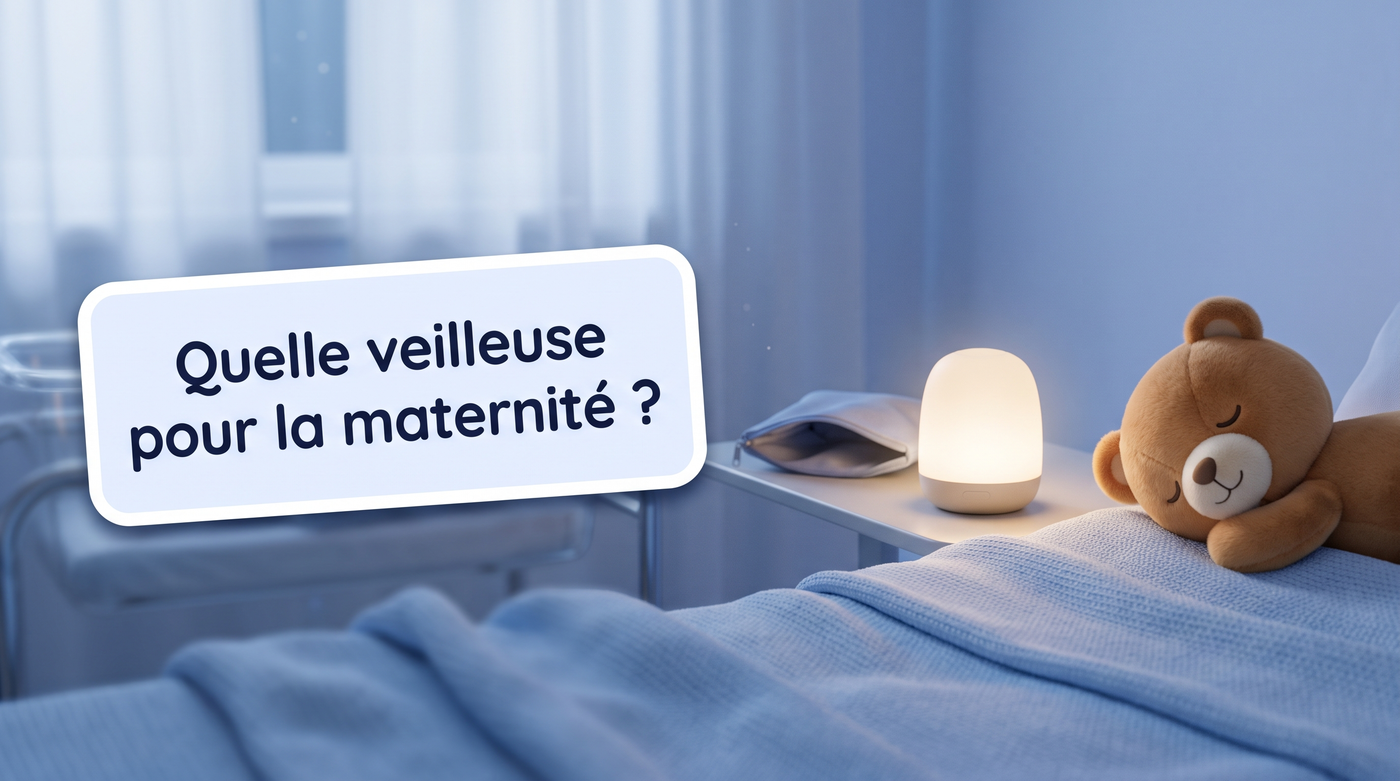
For your maternity stay, go for a portable, rechargeable night light with adjustable brightness, in a warm or red light. It should switch on with one hand, give just enough light for a feed or a nappy change, and stay discreet if you're sharing a ward. Projectors, lullabies and sound sensors are for home, not for a hospital room.
The best night light for a maternity stay isn't the prettiest or the one with the most features; it's the one you can grab at 3 am without hunting for the switch. So which night light should you take to hospital? A cordless lamp that dims right down, soft enough to wake neither your baby nor the person sleeping in the next bed.
The stay may only last a day or two, but it's the nights that count. Here are the criteria that make the difference, the light colour to go for, and the type of design that suits your situation.
Why take a night light to hospital
Maternity wards are lit for the medical staff, not for a newborn. The overhead light is harsh, often cool white, and its switch is rarely within reach of the bed. A night light solves the problem in two seconds, without fully waking anyone.
For breastfeeding and night-time bottles
A night feed rarely lasts five minutes. You need to see how your baby is positioned, without light in their eyes and without waking your own body up. A breastfeeding night light placed next to the bed, set to its lowest, is more than enough for this.
For nappy changes, when you really need to see
A nappy change needs more light than a feed. A night light with adjustable brightness lets you turn it up a notch for the change, then back down straight afterwards. That's exactly what an overhead light can't do.
For a shared ward
In a shared bay, switching on the overhead light wakes everyone, including a baby who had just gone back to sleep. A small light pointed towards your side of the bed stays considerate and saves you going out into the corridor to see properly.
Maternity stay and breastfeeding: two different needs
The two are often confused, and that's what leads people to buy the wrong design. A maternity night light has to last a few days in an unfamiliar room, with no socket available or none in the right place, and then go back in the bag. It's a travel item first and foremost.
A breastfeeding night light, on the other hand, stays put at home, near the chair or the bed. It can be bigger, brighter and plugged in all the time. You choose it for comfort, not for size.
A good maternity night light does both without any trouble. The reverse is far less true: a plug-in design, very handy at home, becomes useless if the only free socket is behind the bed or on the other side of the room.
In hospital, the right night light is the one you can find without looking.
Which light colour to choose
It's the most overlooked criterion, and yet the one that changes the night the most. Not all colours have the same effect on falling asleep, and a cool white light wakes you up more than it lights things up.
What we know about light and melatonin
The cells in the retina that inform the body clock are mostly sensitive to blue, around 460 to 480 nanometres. It's this range that most suppresses the release of melatonin, the hormone associated with falling asleep. Research on light and melatonin by Inserm, the French national health research institute, confirms the central role of this receptor.
At the other end of the spectrum, long wavelengths, between 620 and 700 nanometres, are the least disruptive. That explains the popularity of the red light baby night light in the first few months.
Red and amber: the kindest to sleep
A red or amber light gives enough light to find your way, pick up your baby and check a nappy. It shows colours poorly, which is its only real drawback: check any redness or a nappy's contents under a different light.
Warm white: the sensible compromise
Warm white is still the most versatile setting when you only want one mode. It gives enough light for a nappy change and stays soft at low brightness. Cool white and blue, on the other hand, have no place in a bedroom at night.
These pointers are general and don't replace any professional advice. For anything to do with your baby's sleep or health, your midwife, health visitor or paediatrician is the right person to ask.
The 4 criteria that really matter
Product pages list dozens of features. On a maternity ward, only four make a real difference.
Brightness that dims right down
Many night lights offer three levels, the lowest of which is still too bright. Look for continuous dimming, or a first setting that's genuinely discreet. That low setting is what lets you leave it on all night without bothering anyone.
Rechargeable, so you don't depend on a socket
You don't know where the sockets will be, or whether they'll be free. A rechargeable baby night light goes wherever you need it: on the bedside tray, on the bed, on the changing surface. Check the stated battery life, and charge it fully before you leave for hospital.
Portable and lightweight
A portable maternity night light moves around with you, from the ward to the bathroom, then from your bag to home. A stable base matters as much as the weight: a hospital bedside tray is narrow and easily knocked. That's the whole point of portable, rechargeable designs, made to stand on their own with no cable or stand.
A touch control you can use with one hand
You'll have a baby in one arm. A large touch button on top can be reached without looking or searching. Remote controls, meanwhile, fall between the bed and the wall at the first movement.
 An example Portable Touch Night Light Warm white or cool white at a touch, adjustable brightness, 22.5 hours of battery life, USB rechargeable, 200 g and 13 cm tall. View the night light
Types of night light for a maternity stay
Not every format works equally well for a stay of a few days. Here's what each one offers, its limitation in this specific context, and the matching range if you want to explore a particular format.
| Type | Why it helps in hospital | Its limitation |
|---|---|---|
| Portable rechargeable | Goes anywhere, needs no socket, goes back in the bag | You have to remember to charge it before you leave |
| Plug-in | Never runs flat, very compact | Needs a free, well-placed socket, which is rarely the case |
| Soft silicone | Doesn't heat up, survives being dropped, can sit on the bed | Often not bright enough for a nappy change |
| Projector | Keeps a visiting older sibling busy | Movement on the ceiling stimulates more than it soothes at night |
| White noise | Covers corridor noise | Sound is a nuisance on a shared ward; best kept for home |
| Light-up alarm clock | Useful later, around age 2 or 3 | No use for a newborn, and the display is often too bright |
Five designs compared
To make all this concrete, here are five night lights from our range, one for each use identified above. None of them ticks every box, and that's exactly why it's worth putting them side by side.
| Design | Light | Power | Ideal for |
|---|---|---|---|
|
Portable Touch Night Light
|
Warm white or cool white, brightness set by touch | USB rechargeable, 22.5 h stated | The hospital bag, from the first day to the last |
 Portable White Whale Silicone Night Light Portable White Whale Silicone Night Light
|
7 colours, touch or remote control | USB rechargeable, 3 h timer | Breastfeeding in bed, BPA-free silicone that doesn't heat up |
 Rechargeable Portable Mushroom Night Light Rechargeable Portable Mushroom Night Light
|
Warm, dimmed light | USB rechargeable, 30 min timer | Night-time nappy changes, placed next to the changing surface |
 Red Round Plug-In Night Light Red Round Plug-In Night Light
|
Warm red light, 6.2 cm in diameter | Plug-in, dusk-to-dawn sensor | Back at home, as a permanent night-time marker |
 Jellyfish Night Light with White Noise Jellyfish Night Light with White Noise
|
Multicolour LEDs, brightness adjustable by touch | USB rechargeable, 5 white noises and lullabies | Nights at home; avoid on a shared ward |
Four of these five designs are USB rechargeable, which remains the deciding factor for a hospital room. The fifth plugs into a socket, so it only belongs in a hallway or a room you already know.
Which night light for your situation
The right design mostly depends on how you'll be spending your nights. Five situations come up almost every time, and they don't lead to the same choice.
The hospital bag
For a hospital bag night light, the number one criterion is size. A cordless, lightweight design with no power cable to wind up slips in next to your wash bag and weighs next to nothing. Think about timing too: order well before your due date, as with the rest of our night lights designed for little ones.
Breastfeeding in bed
If you breastfeed lying down, the night light will end up on the mattress or very close to it. A soft material that doesn't heat up or break is then better than glass or metal. A timer also saves you getting up to switch it off once your baby is back asleep.
Along these lines Portable White Whale Silicone Night Light BPA-free silicone that doesn't heat up, 7 colours via touch sensor or remote control, a 3-hour timer and USB charging. View the night light
Night-time nappy changes
Here you need light, but not everywhere. A directional night light, or one simply placed next to the changing surface on a medium setting, does the job. Turn it down as soon as the nappy is fastened, before settling your baby back down.
After a caesarean
Getting up is hard work in the first few days. Choose a design that switches on from the bed, without stretching your arm to its limit, and put it on the side you get up from. This is where a timer really comes into its own.
Twins
With two babies, wake-ups come one after another and the light stays on longer. Go for generous battery life and a good-quality low setting, even if it means taking a second night light for the second cot.
Useful features and pointless gadgets
A packed product page is no guarantee of quality. Here's how we'd sort things for a maternity stay.
- Dimming, continuous or with a very low setting
- Rechargeable battery via USB
- Timer so you don't have to get up
- Touch control on top
- Stable base and a material that doesn't heat up
- Star projection, too stimulating at night
- Lullabies, awkward on a shared ward
- Sound sensor, which switches on at the slightest corridor noise
- Alarm clock display, no use for years yet
- Remote control only, which gets lost in the sheets
Safety and standards to check
A night light placed near a newborn is still an electrical appliance. CE marking commits the manufacturer to meeting European requirements, and the RoHS directive restricts hazardous substances in components. Our designs are CE and RoHS compliant, and checked before dispatch.
Two standards come up depending on the type of product. EN 60598-2-12 covers night lights that plug into a mains socket. EN IEC 62115 covers the safety of electric toys, under the EU Toy Safety Directive 2009/48/EC, whenever the product is intended for play.
Also check three practical points: that the product doesn't heat up after several hours switched on, that no small parts come loose, and that the charging cable can be stored away from the bed. These habits still apply later, with night lights for older children, when the lamp passes into their hands.
A night light is useful from the very first nights because it's the parent who uses it. The child handling it comes much later: from 18 months for a one-piece soft silicone design, and from age 3 as soon as there's a remote control, a button battery, glass or small parts.
Designs to avoid
Four mistakes come up again and again in feedback from new parents. All of them can be spotted before you buy.
Designed as a bedside lamp, it lights up the whole room and has no setting low enough for a feed.
A single harsh, bluish shade. It wakes you up instead of helping you along, and makes getting back to sleep take longer.
With no battery, it depends on a free socket in the right place. In a hospital room, that's a gamble.
Projection, music, sound sensor. Too many features to turn off in the dark, and a whole ward woken up.
FAQ
Which night light should you take to hospital for the birth?
A portable, rechargeable night light with adjustable brightness, in a warm or red light. It should switch on with one hand, last several nights without recharging and stay discreet enough for a shared ward. The format matters as much as the light: lightweight and stable on a narrow bedside tray.
Does the maternity ward provide a night light?
Rarely. Rooms have overhead lighting and sometimes a wall-mounted reading light, designed for medical care rather than a night feed. Equipment varies from one hospital to another, and bringing your own night light is the only way to be sure of having soft light within reach.
What light colour is best for a maternity night light?
Red and amber are the kindest to sleep, because long wavelengths have little effect on melatonin. Warm white is a good compromise when you need to see for a nappy change. Avoid cool white and blue at night: they wake you up more than they light things up.
From what age can you use a night light?
From birth in the room, since it's the parent who uses it. The child handling it comes later: from 18 months for a one-piece soft silicone design, and from age 3 as soon as there's a remote control, a button battery, glass or small parts.
Will a rechargeable night light last all night?
For most designs, yes, as long as you turn the brightness down. The stated battery life is based on low-brightness use, and a night light on full brightness runs down much faster. Charging it fully before you leave for hospital avoids any nasty surprises.
Want to bring a little softness into the nursery?
Nearly 400 designs, CE and RoHS compliant, checked before dispatch.
VISIT THE SHOP