
Pink noise: what it is, how it differs from white noise and its effects on sleep
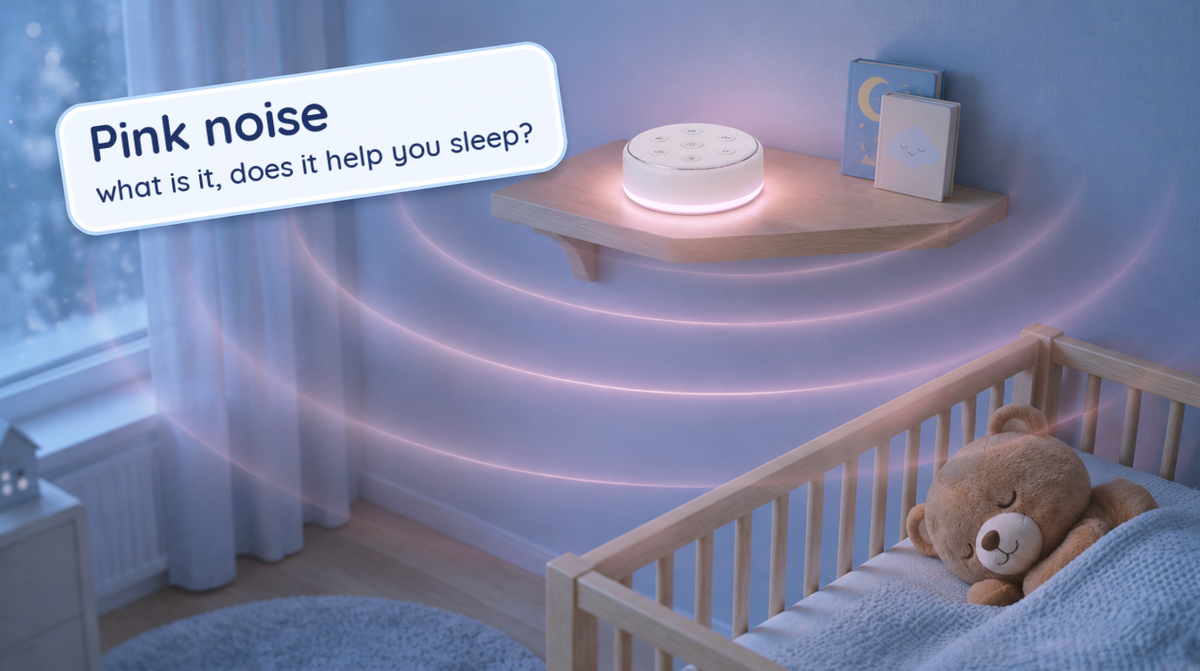
Pink noise is a steady background sound, close to white noise but with less treble: it sounds deeper and softer. Nothing proves it helps you sleep better, and a 2026 study measured less REM sleep in adults exposed to it all night. If you use it: low volume, device far from the bed, timer on.
Pink noise has left the acoustics lab for sleep playlists, apps and social media. It is often presented as the gentle version of white noise, the one that supposedly helps you sleep more deeply.
We sell white noise night lights, not pink noise machines. So we tell you what studies really say, how to listen to it with care, and what our white noise night lights do, without claiming things they don't do.
This article gives general guidance drawn from published studies; it is not a substitute for medical advice. If your child's sleep or your own worries you, or if you have tinnitus, talk to your GP, your paediatrician or an ENT specialist.
Pink noise: a simple definition
Pink noise is a noise whose energy is the same in every octave, from bass to treble. As a result, it contains fewer high frequencies than white noise, according to the definition of the Office québécois de la langue française (Quebec's official French language office). To the ear, it sounds deeper, more muffled, less “hissy”.
Cleveland Clinic describes it as a toned-down version of white noise, in which the low frequencies stand out more. To picture it, many media outlets compare it to steady rain or rustling leaves. The name “white noise” itself comes from an analogy with white light, which mixes all colours. But rain is only an image: a recording of rain or waves is not pink noise in the technical sense; it is a natural sound that changes all the time.
White, pink or brown noise: the differences
All three noises contain every audible frequency; what changes is the share of bass. White noise is the highest-pitched and the “busiest”, pink noise is softer, and brown noise (also called red noise) is the deepest, close to a rumble.
| Noise | What you hear | Common comparison |
|---|---|---|
| White noise | All frequencies at the same level: a sharp, busy hiss | Static, a radio between stations |
| Pink noise | Same energy per octave, so less treble: deeper and softer than white | Steady rain, rustling leaves |
| Brown noise (or red) | The most emphasis on bass: a muffled rumble, very little treble | Waterfall, distant thunder |
Sources: OQLF, “bruit rose” entry (in French); Cleveland Clinic, “Brown noise” (2024); Futura (2024, in French). The comparisons in the last column are images, not equivalents.

Brown noise or red noise: is it the same thing?
Yes, brown noise and red noise are two names for the same sound. Cleveland Clinic presents it as the noise that puts the most emphasis on low frequencies, and points out that research on its effects is still very thin.
Does pink noise help you sleep? What the research says
No, nothing proves to date that listening to pink noise all night helps you sleep better. A review of 38 articles rates the evidence for continuous noise as “very low”, and a laboratory trial published in 2026 measured less REM sleep under pink noise. The study often cited in its favour tests something else.
| Study | Date | What it showed |
|---|---|---|
| Ngo et al., Neuron | 2013 | Very short bursts of sound, timed by computer to the slow waves of deep sleep, improved memory in adults. This is not pink noise played continuously all night. |
| Riedy et al., Sleep Medicine Reviews | 2021 | Review of 38 articles on continuous noise (white or similar) and sleep: contradictory results, evidence of a positive effect rated very low. |
| Basner et al., Sleep | 2026 | 25 adults, 7 nights in the laboratory. On its own, pink noise at 50 dBA reduced REM sleep by about 19 minutes compared with a quiet night. Earplugs protected better against outside noise than pink noise. |
| Basner et al., Sleep Health | 2026 | Same trial: pink noise reduced awakenings caused by aircraft noise, all the more as it was louder, but less well than earplugs. |
What we can take from this: pink noise can partly mask a disturbing noise (street, neighbours, aircraft), but it does not “fix” sleep. In the 2026 trial, added to outside noise, it even disrupted sleep structure. The authors call for avoiding broad, indiscriminate use while waiting for further studies.
White noise raises the same questions. Our article on hoover noise for babies explains why some parents use it to help baby fall asleep, and with what limits.
Pink noise and babies: why caution is wise
For a baby, researchers urge caution. REM sleep makes up about half of a full-term newborn's sleep and plays an important role in brain development at that age, Basner and colleagues point out in 2026. Since pink noise reduced it in adults, they consider it probably justified to advise against background noise for newborns and toddlers, pending confirmation studies.
They specify that their trial involved adults and that it is not yet known whether the effect is the same in children. A 2024 review (De Jong et al., Sleep Medicine) also argues for caution, in another form: limiting the maximum volume and listening time of white noise machines used for young children.
In practice, if you use background sound to help your baby fall asleep, the most cautious approach is to keep it short: during bedtime, with a timer that then switches the sound off, rather than all night. Our guide to the baby bedtime routine suggests a ritual in which sound is just one step among others.
Volume, distance, duration: practical tips
The right setting comes down to three words: low, far, short. The lowest volume that still works, the device as far from the bed as possible and never in the cot, a timer rather than a whole night. No study sets a safe volume for the home: the table brings together what the sources say about volume and duration, mostly for white noise machines; we apply it to pink noise too, as there is no dedicated study.
| Source | Date | Guidance |
|---|---|---|
| Basner et al., Sleep | 2026 | Volume and duration: played all night at 50 dBA, pink noise reduced REM sleep in healthy adults. The authors call for avoiding broad, indiscriminate use. |
| De Jong et al., Sleep Medicine | 2024 | Maximum volume: some white noise machines can exceed 91 dB at full volume. The authors argue for limiting the maximum intensity and listening time of these devices. |
| Cleveland Clinic | 2024 | Duration: listen in sessions of 10 to 15 minutes, with a timer for falling asleep, at a moderate volume, rather than all night. |
Start at the lowest volume
Only turn it up until it covers the disturbing noise, no further. A device can get very loud at full volume: maximum volume is never the right setting.
Keep the device away from the bed
On a chest of drawers or a shelf, on the other side of the room. Never in the cot, on its bars or next to the pillow.
Set a timer
The sound accompanies falling asleep, then stops. De Jong et al. (2024) and Cleveland Clinic point the same way: a limited duration rather than a whole night.
Check with a sound meter
A sound-measuring app on your phone, placed where your child sleeps, gives a rough idea. It is not a laboratory instrument, but it is better than guessing.
Pink noise and tinnitus
None of the studies cited in this guide looks at tinnitus: so we cannot say whether pink noise relieves it. Some people use background sound to mask the ringing in the evening, but it is not a treatment. If you have tinnitus, talk to your GP or an ENT specialist before buying anything.
Which device for background sound at night?
To listen to actual pink noise, you need a recording labelled “pink noise”: you can find them on music platforms, sound apps and online generators. On a phone, the tips in the volume section apply too.
Do our night lights play pink noise?
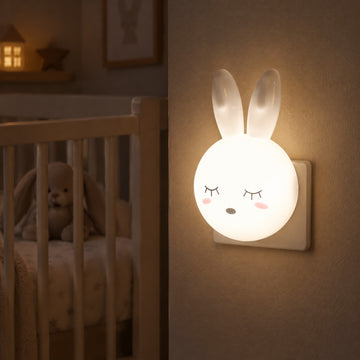
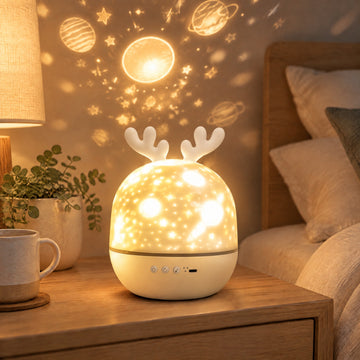
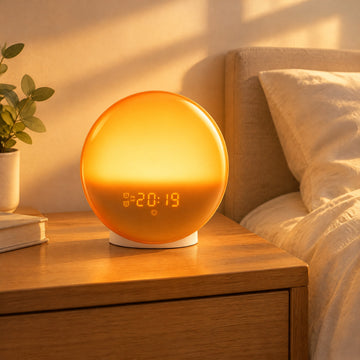
No. None of our night lights has a “pink noise” mode. Our white noise night lights play white noise and, depending on the model, lullabies and sounds such as rain, waves, a fan or a heartbeat. These natural sounds are not pink noise. They have adjustable volume, a timer and a soft light.
Our selection: adjustable volume and timer
We chose these white noise night lights for what matters in the tips above: a finely adjustable volume and a timer that switches the sound off. The sounds listed are those on each product page.
 Fine volume White Noise Night Light for Babies 26 sounds, including heartbeat, waves and light rain, 15 volume levels, 6 timers from 30 min to 3 h, glow with 3 brightness levels. £39.90 See the night light
 On the chest of drawers White Noise Night Light with 34 Sounds Lullabies, waves, fan and heartbeat, adjustable volume, 30, 60 or 90-minute timer, 7 colours, USB rechargeable. £39.90 See the night light
 To hang up White Noise Night Light with 20 Sounds White noise, lullabies, waves, stream and birds, 15, 30 or 60-minute timer, adjustable volume, strap to hang it out of baby's reach. £36.90 See the night light
 For adults Adult White Noise Night Light 34 soundscapes, including rain, ocean and fan, 32 volume levels, 30, 60 or 90-minute timer, 7 light colours. £43.90 See the night light
To compare the models one by one, our top white noise night lights ranks them by use. Models designed for little ones are also in our baby night lights collection, and bedside lamps for grown-ups in our adult night lights.
FAQ: your questions about pink noise
What is the difference between white noise and pink noise?
White noise contains all frequencies at the same level, which gives it a sharp sound, close to a hiss. Pink noise keeps the same energy in every octave, so less treble: it sounds deeper and softer. Both are steady background sounds, with no melody.
Does pink noise really help you sleep?
Nothing proves it to date. A review of 38 articles published in 2021 rates as very low the evidence that continuous noise improves sleep. In 2026, a trial of 25 adults measured about 19 minutes less REM sleep under pink noise at 50 dBA.
Is pink noise dangerous for babies?
Harm has not been proven, but researchers urge caution. Basner's team (2026) considers it probably justified to advise against background noise for newborns and toddlers, whose REM sleep plays an important role in development, pending further studies. If you use it: low volume, device far from the bed, timer on.
Brown noise or red noise: is it the same thing?
Yes, brown noise and red noise are two names for the same sound. It is the deepest of the three colours of noise: it emphasises low frequencies and sounds like a muffled rumble, like a waterfall or distant thunder.
How do you use pink noise to fall asleep?
Pink noise is best used only for falling asleep: the lowest volume that covers the disturbing noise, device or phone far from the bed, a timer that switches the sound off. Cleveland Clinic advises sessions of 10 to 15 minutes rather than listening all night.
Do your night lights play pink noise?
No, no Rêve de Veilleuse night light has a pink noise mode. Our white noise night lights play white noise and, depending on the model, lullabies and natural sounds such as rain or waves, with adjustable volume and a timer. The full list of sounds is on each product page.
Sources
- Basner M. et al., “Efficacy of pink noise and earplugs for mitigating the effects of intermittent environmental noise exposure on sleep”, Sleep, 2026: doi.org/10.1093/sleep/zsag001
- Basner M. et al., “The efficacy of pink noise and earplugs for mitigating sleep disruption induced by different environmental noise sources”, Sleep Health, 2026: doi.org/10.1016/j.sleh.2026.03.009
- Riedy S.M. et al., “Noise as a sleep aid: A systematic review”, Sleep Medicine Reviews, 2021: doi.org/10.1016/j.smrv.2020.101385
- De Jong R.W. et al., “Continuous white noise exposure during sleep and childhood development: A scoping review”, Sleep Medicine, 2024: doi.org/10.1016/j.sleep.2024.04.006
- Ngo H.-V. V. et al., “Auditory closed-loop stimulation of the sleep slow oscillation enhances memory”, Neuron, 2013: doi.org/10.1016/j.neuron.2013.03.006
- Cleveland Clinic, “Brown noise”, 28 March 2024: health.clevelandclinic.org
- Office québécois de la langue française, “bruit rose” entry (in French): vitrinelinguistique.oqlf.gouv.qc.ca
- Futura, article on white noise, pink noise and sleep, 18 March 2024 (in French): futura-sciences.com
Background sound, set low and switched off in time
White noise, lullabies and natural sounds, with adjustable volume and a timer, to place far from the bed.
DISCOVER OUR WHITE NOISE NIGHT LIGHTS