Hoover Noise for Babies: Why It Calms Them and How to Use It
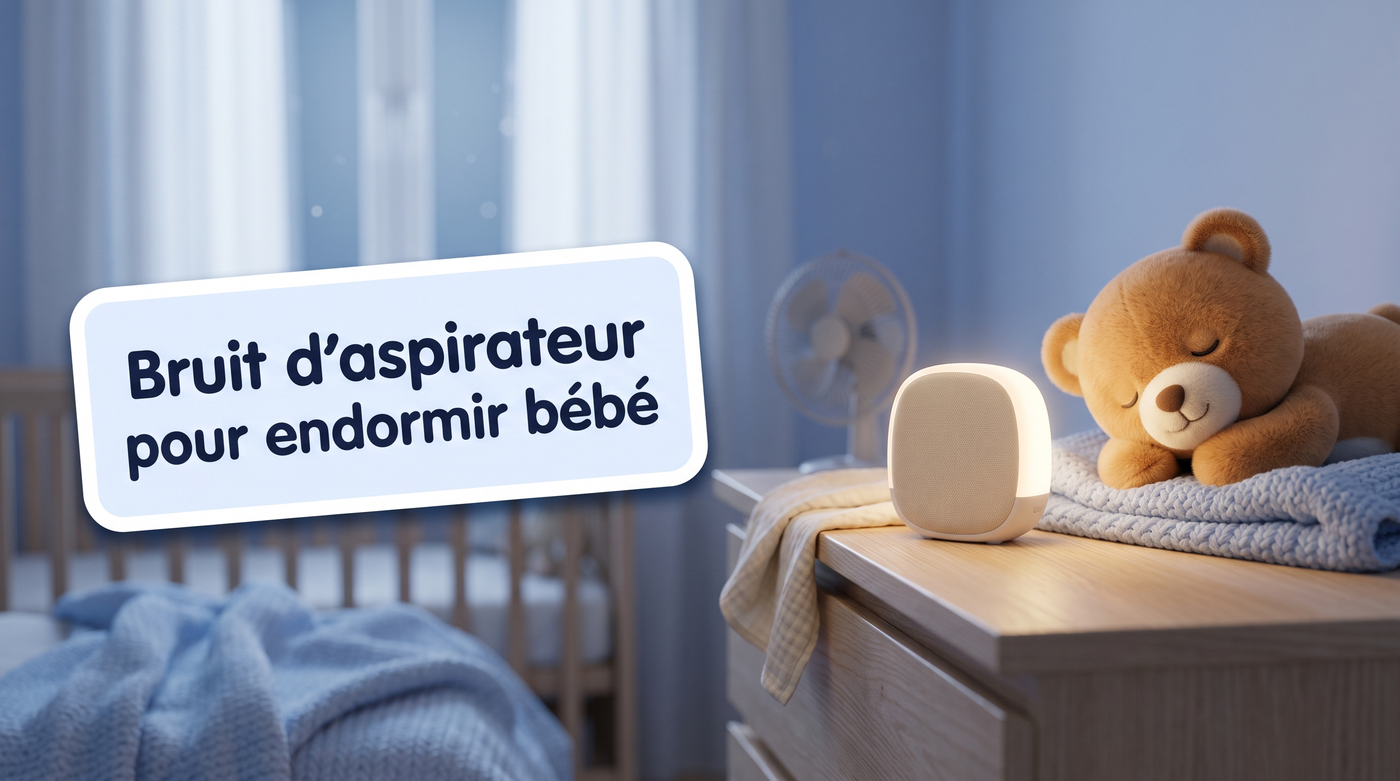
Hoover noise calms babies because it echoes the soundscape of the womb, where they spent nine months surrounded by constant noise. This white noise helps them fall asleep and masks stray sounds. To use it safely: keep the volume under 50 decibels, place the device at least 2 metres from the cot, and switch it off once your baby has dropped off.
You've probably noticed it already: the sound of a hoover often soothes a crying newborn almost instantly. Parents have been puzzled by it for generations, and there is an explanation. Hoover noise belongs to the wider family of white noise, those constant sounds that remind your baby of an environment they know very well indeed.
But while the trick works, it calls for a little caution. Volume, distance, length of exposure: several things need watching to protect your little one's delicate hearing. This article explains why it works, how to use it safely, and which more practical alternatives exist. If you're already looking for a dedicated device rather than a hoover, our baby night light range only features models designed for the early months, made from soft one-piece silicone.
Why hoover noise calms your baby
The soothing effect of hoover noise is no coincidence. It relies on two complementary mechanisms: a sensory memory of life in the womb, and an acoustic phenomenon called sound masking. Together, they create an environment that makes falling asleep easier.
A reassuring echo of the sounds of the womb
During nine months in utero, your baby never experienced silence. Quite the opposite: they were immersed in a remarkably rich world of sound, from their mother's heartbeat and blood flow to tummy rumbles and muffled voices. The available measurements put this constant background noise at a high level, comparable to a household appliance running.
When a newborn hears this kind of sound after birth, they recognise something familiar. The steady hum is linked to a known environment, and calm follows: the heart rate slows, breathing settles, and sleep comes more easily.
The sound-masking effect
The second mechanism is purely acoustic. The white noise a hoover produces covers every audible frequency evenly, creating a kind of wall of sound that masks stray noises around the house.
A door slamming, a neighbour talking, a car going past in the street: any of these can wake a baby in light sleep. Continuous white noise smooths out these sudden changes and lets your child stay in their sleep cycle without interruption.
A study published in Archives of Disease in Childhood in 1990 observed that 80% of newborns exposed to white noise fell asleep in under 5 minutes, compared with 25% without it. It's the figure quoted everywhere, but it is based on a sample of 40 newborns. Solid as an observation, not enough to make it a general rule.
What we know, and what we don't
Let's be clear about the state of knowledge: the soothing effect of white noise on young babies is widely observed but little studied. The available research is old and based on small numbers. No professional body recommends white noise as a sleep tool, and none advises against it either, as long as the volume is kept under control.
The idea of the fourth trimester helps explain why it works mainly in the early weeks. The first three months after birth are a period of transition: the baby leaves a snug, noisy environment, and anything that recreates a little of that cocoon eases the change. It's also why the effect fades naturally as they grow.
How to use it safely
White noise is still a sound stimulus, and a young baby's ears are delicate. Exposure that is too loud or too long can tire them for no good reason. Three settings are easy to control: volume, distance and duration.
Volume: stay under 50 decibels
The 50-decibel benchmark comes from the level the American Academy of Pediatrics recommends for background noise in neonatal units. It has since been adopted as a reference for baby white noise machines, and it is now the widely agreed figure. For comparison, it is roughly a quiet conversation or the hum of a fridge.
A running hoover is well above that level. That's exactly why a dedicated device with fine volume control is better than a hoover you can only switch on or off. You can measure the real level with a sound-meter app on your phone, held at the height of your baby's ear. Our white noise night lights all offer volume control, which is the first thing to look for.
Distance: at least 2 metres from the cot
Two metres is the distance commonly recommended between a white noise source and your child's head. It greatly reduces the sound level that reaches them without taking anything away from the masking effect.
The 2 metres apply to sound. For the light from a night light, the benchmark is quite different: between 50 centimetres and 1 metre, out of your child's line of sight. On a device that does both, the sound rule wins: place it further away and accept that the light will be more indirect.
Duration: help them drift off, then switch off
This is where advice found online often makes up numbers. There is no official duration by age group. The principle, on the other hand, is simple and widely agreed: white noise is there to help your baby fall asleep, it doesn't need to run all night. A timer sorts this out without you having to get up again.
| Age | What never changes | Our rule of thumb |
|---|---|---|
| 0 to 3 months | Under 50 dB, at least 2 m away | This is when it is most useful. At bedtime, and during crying spells. |
| 3 to 12 months | Under 50 dB, at least 2 m away | Still at bedtime, with a timer that switches off once sleep has set in. |
| 12 months and over | Under 50 dB, at least 2 m away | Occasionally. A good time to start cutting back. |
The right-hand column is our own rule of thumb, not an official recommendation. The two rules on the left are the widely agreed ones.
 An example
White Noise Night Light for Babies
Fifteen volume levels so you can go really low, twenty-six sounds, and a timer with six settings from 30 minutes to 3 hours.
View the night light
An example
White Noise Night Light for Babies
Fifteen volume levels so you can go really low, twenty-six sounds, and a timer with six settings from 30 minutes to 3 hours.
View the night light
Warning signs to look out for
Watch for signs that white noise doesn't suit your baby. Repeated startling, restlessness that increases instead of settling, crying that gets worse as soon as it's switched on. If your baby seems uncomfortable, turn the volume down, move the device further away, or simply stop. And if you have the slightest doubt about their hearing or their sleep, speak to your GP or health visitor, not a blog post.
White, pink or brown noise: what's the difference?
Not all constant noises are equal. Hoover noise is a type of white noise, but there are several "colours" of noise, each with its own characteristics. Understanding the differences helps you choose the most suitable sound.
- White noise: energy spread evenly across all frequencies. It's the sound of a hoover or a hairdryer. The most effective at masking stray noises.
- Pink noise: more energy in the low frequencies. Gentler on the ear, it's reminiscent of rain or waves. Often preferred for longer listening.
- Brown noise, sometimes called red noise: even more bass. Very low and deep, like a distant waterfall.
| Type of noise | Dominant frequencies | Often preferred for |
|---|---|---|
| White noise, hoover | All of them, from 20 Hz to 20 kHz | The very first months, and crying spells |
| Pink noise, rain | Low and mid | Longer listening, a child who is sensitive to noise |
| Brown noise, waterfall | Mainly low | Older children, and background ambience |
In practice, hoover noise is most useful for a newborn in the middle of a crying spell, because it is the sound closest to the background noise of the womb. As your baby grows, it's natural to switch to gentler sounds, such as pink noise or lullabies.
Alternatives to a real hoover
Running a hoover in the nursery obviously isn't sustainable day to day: the energy use, the bulk, and above all a volume you can't adjust. Fortunately, there are solutions better suited to regular use.
White noise night lights and machines
This is the most complete solution. These devices offer several sounds, adjustable volume and a timer, and often combine soft light and soothing sound in a single object that sits on a chest of drawers. You can also take a look at our musical baby night lights, which add lullabies to the white noise.
- Finely adjustable volume
- A choice of sounds
- A timer, so you don't have to get up
- Often rechargeable and portable
- Something to buy, when the hoover is already there
- A battery to recharge
- A choice to make among lots of models
 Along these lines
Rechargeable White Noise Night Light 7 Colours
Ten white noise sounds and two lullabies, seven light colours, a timer with three settings and USB-C charging.
View the night light
Along these lines
Rechargeable White Noise Night Light 7 Colours
Ten white noise sounds and two lullabies, seven light colours, a timer with three settings and USB-C charging.
View the night light
Free recordings
If you'd like to try white noise before buying anything, music streaming services and video sites offer recordings several hours long: just search for "baby white noise". There are also dedicated phone apps.
Two caveats, though. A phone left in a baby's room rarely ends up two metres from the cot, and it gets warm. And a recording on loop with no timer plays all night, which is exactly what you want to avoid. It's a good way to test the idea, not a good long-term set-up.
What you already have at home
Facing away from the cot, on the lowest speed, never pointed at your child. A constant noise very close to white noise.
An ultrasonic model produces a steady whoosh and humidifies the air at the same time. Two benefits in one.
Speed 1, door open, to calm a crying spell from the next room. Now and then, never all night.
In the next room, door ajar. It's the only way to respect the distance without moving it.
A hairdryer left running unattended, even at a distance. The sound is right, but the appliance gets very hot and isn't designed to run for long. The risk of burns and fire has no place in a child's room.
Making it part of the bedtime routine
White noise really comes into its own when it's part of a consistent evening routine. It isn't a stand-alone solution: it works alongside the other cues that get your baby ready for sleep, such as dimmed lights, a bath, a cuddle and a lullaby.
Gradually lower the lights around the house and switch on a soft night light in the nursery. It's the first cue, and it comes well before the sound.
Warm water, a calm atmosphere, fifteen to twenty minutes. The drop in body temperature after the bath helps your baby drift off.
In the nursery, in a comfortable position. Avoid screens and lively conversations, which wake your baby back up.
When you put your baby down, at a moderate volume, with the device two metres away. Set the timer straight away: it's the step people forget, and it makes all the difference.
Once your baby is drowsy but not yet asleep, slip out. The white noise keeps them company, then stops on its own, without you having to go back in.
Cutting back as they grow
Somewhere between one year and eighteen months, most children no longer need white noise to fall asleep. Many keep it anyway, simply out of habit. That's not a problem in itself, but it's a good time to start cutting back.
The method is the same as for any bedtime habit: go in small steps, never all at once. First shorten the timer, then lower the volume, then switch to a gentler sound, and finally do without it. If a step doesn't go well, go back to the previous one for a few days. The pace depends on your child, not on a calendar.
Your questions about hoover noise
From what age can you use hoover noise for a baby?
White noise can be used from birth, and that's actually when it works best. During the first three months, babies are especially receptive to sounds that remind them of the womb. Just make sure you stay under 50 decibels and place the source at least 2 metres from the cot.
How long should you play hoover noise to a baby?
There is no official duration by age group, despite what you often read. The widely agreed principle is simpler: white noise helps your baby fall asleep, then you stop it. A 20 to 30-minute timer usually covers the shift into deep sleep, without you having to go back into the room.
Can white noise make a baby dependent on it?
Used every time, it can become a sleep association: your child finds it harder to fall asleep without it. It isn't a dependency in the medical sense, more a habit, just like a comforter or a bedtime story. To stop it becoming too ingrained, alternate with other ways of soothing and start cutting back at around one year.
Is hoover noise bad for a baby's ears?
A hoover running right next to a baby is too loud for a young baby's ears, and repeated exposure at that level isn't a good idea. That's why the 2-metre distance and the 50-decibel limit matter so much. A dedicated device with fine volume control is much easier to manage than a hoover.
Should white noise play all night?
It isn't recommended. Continuous playback keeps a background noise going through the light-sleep phases, when the aim was only to help your baby fall asleep. Good practice is to set a timer for long enough for your baby to fall into a deep sleep, then let the room return to quiet.
Looking to bring a little calm to your baby's nursery?
White noise night lights, musical models, star projectors: models with adjustable volume and a timer, CE and RoHS compliant.
VISIT THE SHOP