Which Night Light to Choose for an Elderly Person?
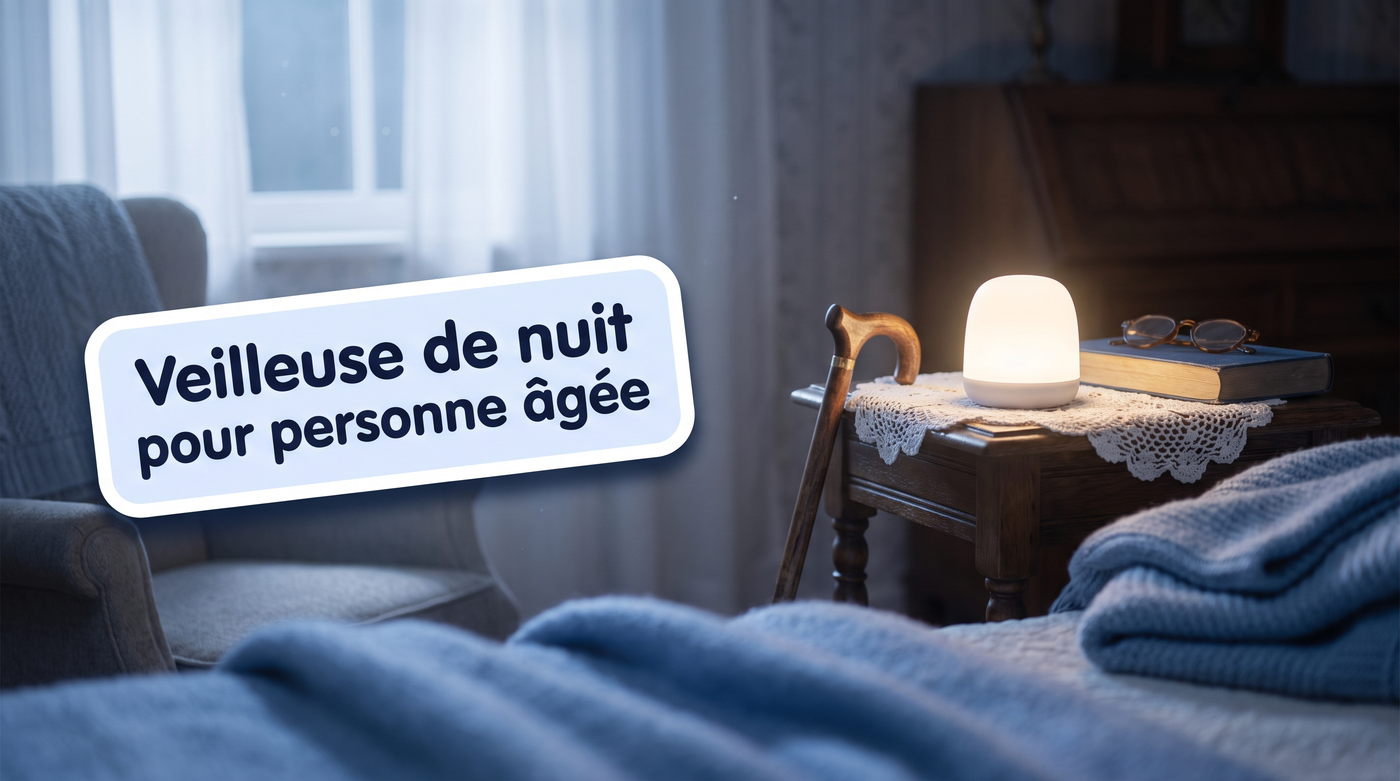
For an older person, choose a motion sensor night light with warm, soft light. Put one in the bedroom, the hallway and near the bathroom to make night-time trips safer. For someone who gets disorientated at night, go for a dusk-to-dawn design that stays on until morning.
As we get older, getting up in the night becomes a delicate moment. Going to the toilet, heading to the kitchen for a glass of water, or simply crossing a dark hallway: ordinary things that, after 65, can turn into a risk of falling. A night light for an elderly person addresses exactly this, giving just enough light to find the way without disrupting sleep.
You still need to choose the right design, because an older person's needs have nothing in common with a child's. That's exactly why our adult night light range exists: it only includes designs with no childish motifs, which look at home in any bedroom. This guide covers the right types, the technical criteria that count, the rooms to equip first, and what to know about financial help.
Why a night light matters after 65
This isn't about decor, it's about safety. For older people, a lack of light at night is one of the easiest fall risk factors to fix, and one of the least often fixed.
Falls: a risk that isn't going away
The figures published by Santé publique France, the French public health agency, for 2024 are unambiguous: in France, 174,824 hospital admissions and 20,148 deaths were linked to a fall among people aged 65 and over. Despite a national falls-prevention plan launched there in 2022, these numbers keep rising, with deaths up by around 18% in five years.
Obviously, not all these falls happen at night, and nobody publishes a reliable breakdown by time of day. But getting up in the night combines all the known risk factors: eyes poorly adjusted to the dark, blood pressure dropping on standing up, a cluttered floor you can't see. That's precisely where a light makes a difference.
How eyesight changes with age
From 60 onwards, the eye takes longer to adjust to the dark. The lens gradually becomes cloudier, the pupil dilates more slowly, and sensitivity to contrast decreases. Someone woken in the middle of the night may take several minutes to make out the outline of a room properly, when they're already on their feet.
On top of this there's often a loss of balance, dizziness on getting up, or side effects of certain medicines that make the first steps unsteady. A soft but sufficient transition light makes up for this adjustment time and gives the body time to steady itself.
Cognitive impairment
For people living with Alzheimer's disease or other forms of dementia, night-time is often a source of anxiety and disorientation. A phenomenon known as sundowning can cause agitation, wandering and confusion as daylight fades.
A night light with a warm, steady light, left on all the time, then acts as a visual landmark. It helps the person recognise their surroundings and find their way back to the bedroom. For these situations, avoid designs that switch off after a few seconds: a light that disappears at the wrong moment adds to the confusion rather than easing it.
This article gives general guidance. A person's risk of falling depends on their eyesight, balance and medication, and that assessment is for their GP. A night light is a comfort and safety measure, not a medical solution.
The five types of night light for older people
Not all night lights meet the same needs. There are five main families, each with its own uses.
The motion sensor night light
This is the best design for someone who is still independent. An infrared sensor switches the light on as soon as it detects someone, then switches it off after a few tens of seconds. Nothing to operate, no switch to hunt for in the dark, and no power used for the rest of the night.
It's best suited to hallways, the area around the bathroom and landings. Look for two figures on the product page: the sensor range, often 3 to 5 metres, and the time before it switches off, which ranges from a few tens of seconds to several minutes depending on the design. Too short, and it goes off mid-journey.
 An example Motion Sensor Plug-In Night Light 120° detection over 3 to 5 metres, switches off 30 seconds after movement stops, three modes: on, off and automatic. View the night light
The dusk-to-dawn night light
A dusk-to-dawn sensor works differently: the night light switches on as soon as the surrounding light fades, and stays on until the first light of morning. Nothing to remember, nothing to switch off.
This is the system for people who need a constant light, particularly with cognitive impairment or frequent waking. It uses a little more power than a motion sensor, but a night light LED stays under one watt: over a year, the difference is tiny.
The plug-in night light
Discreet and reliable, it plugs straight into a wall socket. No installation, no batteries, no cluttered bedside table. Most plug-in designs also include a dusk-to-dawn sensor or a motion sensor, which makes them the simplest format for equipping several rooms without having to think about it. You'll find them all in our plug-in night light range.
The portable rechargeable night light
Cordless, it can be carried from room to room, placed on the bedside table or taken to the toilet. It's an invaluable solution for people with reduced mobility, who want a light within reach before they even get up. It has another rarely mentioned advantage: it keeps working during a power cut. Our portable, rechargeable designs come in every format, from the most compact to the brightest.
The LED light path
Self-adhesive LED strip or illuminated skirting, fixed along a route: under the bed, along a hallway, on the risers of a staircase. Triggered by movement or by dusk, it marks out the route rather than lighting a room.
It's the most complete solution for a home on several floors or for someone whose eyesight is clearly declining. It takes a little DIY, or help from a relative, but it tackles the problem where it really lies: at floor level.
Where to put them around the home
A single night light won't make a home safe. The idea is to think in terms of a night-time route: where does the person go at night, and where do they hesitate? Four areas deserve to be equipped first.
A low light, close to the floor, that lights the first steps on getting up without fully waking the person.
The most critical point. At skirting-board height, so the beam lights the floor and feet.
Just enough to reach the basin without switching on the main light. Check that the design can cope with humidity.
The most dangerous area. One night light per landing, and a light path on the risers.
Switch off all the lights and walk the route from the bed to the toilet. Every spot where you hesitate, reach out for a wall or slow down is a spot to equip. This test takes two minutes and is worth more than any advice.
The criteria that really matter
Warm light, never cool
This is the most important criterion, and the one most often ignored. A warm light, tending towards amber, is barely noticeable at night and lets the darkness do its job. A cool white or bluish light wakes the eyes instead of helping them along, and makes it take longer to get back to sleep. On a product page, look for warm white, or a colour temperature of around 2,700 kelvin.
Low brightness that lets you see without dazzling
You can judge the right setting by eye, without any measuring device. If you can read a few lines of a book next to the night light, it's too bright. If you can make out the outline of the furniture and the edge of a step, it's at the right level. It's as simple as that.
Use that asks nothing of anyone
A good night light for an older person is one nobody needs to think about. So go for automatic: motion sensor or dusk-to-dawn. If there's a manual control, it should be large, raised and reachable without looking. A small flat button on the side of a casing is useless in the dark.
Electrical safety
Don't buy a night light without CE marking. LED designs are best: they barely heat up, use very little power and have no bulb to replace. With a plug-in night light, also check that it doesn't block the second socket of a double socket, and that no cable runs across a walkway.
The format, depending on lifestyle
- Always powered, never a flat battery
- Instant set-up, nothing to adjust
- Inexpensive, so you can put one in several rooms
- Motion sensor or dusk-to-dawn, no input needed
- Moves from room to room
- Works during a power cut
- Sits within reach before getting up
- Needs regular recharging
Financial help: what's worth knowing
Let's be frank before anything else: no public scheme reimburses the purchase of a standalone night light. Public support of this kind funds home adaptation work or equipment included in a support plan. Safety lighting can be part of that, but as part of a wider project, never as a one-off purchase.
Home adaptation support
Most public help for staying independent at home is aimed at adaptation work: grab rails, stair lifts, accessible bathrooms and the like. In the UK, this generally goes through the local council, often after an assessment of the person's needs. Eligibility depends on where you live and on the household's circumstances.
Many online articles still point to schemes that have since been scaled back or withdrawn. Before starting any application, check that the scheme still exists and that you are eligible with the organisation concerned. Don't build an application on an old article; you'd be wasting your time.
Needs assessments and support plans
For someone who is losing independence, an assessment of their care needs can lead to a personalised support plan, which may include equipment and safety adaptations. The request is usually made to the local council's adult social care team, and the person's needs are often assessed at home.
Charities, insurers and health cover
Some charities and local organisations that support older people offer advice on home safety and falls prevention. It's worth asking them what help is available in your area.
Finally, some insurance or health cover plans for older people include a prevention allowance that can cover safety equipment on presentation of a receipt. This varies widely from one policy to another; check with your provider, not in an article.
Support for independent living changes regularly, and schemes are regularly reshaped or withdrawn. Always check with your local council or the organisation concerned before starting an application. We sell night lights; we're not benefits advisers.
Three profiles, three designs
Rather than a one-size-fits-all ranking, it's more useful to start from the person. Here are three common situations, and the type of night light that suits each one.
| Design | Who it's for | What makes it suitable |
|---|---|---|
| Motion Sensor Plug-In Night Light |
Someone independent who gets up once or twice a night | 120° detection over 3 to 5 metres, switches off after 30 seconds, nothing to do |
 Warm White Round Plug-In Night Light Warm White Round Plug-In Night Light |
Someone who gets disorientated at night or wakes often | Dusk-to-dawn sensor: it switches on by itself at sunset and stays on until morning |
 Portable Touch Night Light Portable Touch Night Light |
Someone with reduced mobility who wants light before getting up | Cordless, 22.5 hours of battery life, 200 g, switches on with a simple touch on top |
Three designs from our range, one for each situation. The ideal is often to combine them: a motion sensor night light in the hallway and a portable one on the bedside table.
Your questions
Which night light is best for someone with Alzheimer's?
Go for a dusk-to-dawn night light that stays on all night, with a warm light and soft brightness. Consistency is what matters: a light that doesn't change helps the person recognise their surroundings and limits disorientation. On the other hand, a design that switches off after a few seconds can add to the confusion.
Does a night light disturb an older person's sleep?
Not if it stays low and a warm shade. It's cool light and bluish tones that get in the way of falling asleep, far more than the mere presence of a light. The test is visual: if you can read by the night light, it's too bright. If it just lets you make out the outline of the furniture, it's set right.
Can you get financial help for a night light for an older person?
No public scheme reimburses the purchase of a standalone night light. Existing support funds home adaptation work or equipment included in a support plan, where safety lighting may be part of it. Some insurance or health cover plans include a prevention allowance; check your policy.
Should the night light be left on all night?
For someone independent, a motion sensor design that switches on as they walk past is enough, and uses less power. For someone who gets disorientated or wakes often, a dusk-to-dawn night light left on all night is better. The choice depends on the person, not on a general rule.
What's the difference between a motion sensor and a dusk-to-dawn sensor?
A motion sensor only switches the night light on when it detects someone, then switches it off after a few tens of seconds. A dusk-to-dawn sensor switches it on as soon as the surrounding light fades and keeps it on until morning. The first uses less power; the second gives a constant landmark.
Want to make a loved one's nights safer, gently?
Motion sensor night lights, plug-in designs, portable rechargeable formats: warm-light designs with no childish motifs, CE and RoHS compliant.
VISIT THE SHOP