How to Have Sweet Dreams: 7 Ways to Sleep Better at Night
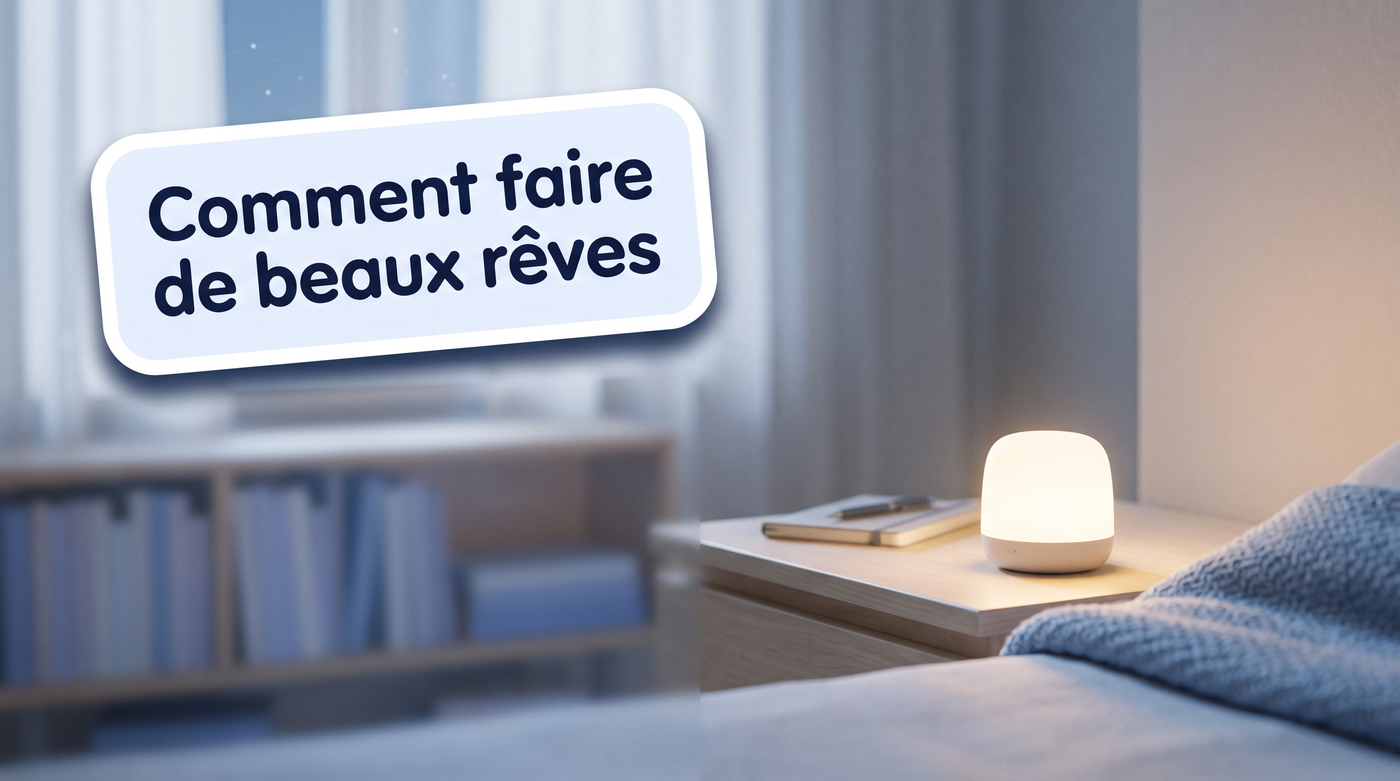
You can't choose your dreams, but you can choose the conditions you fall asleep in, and that's almost the same thing. Three levers are enough to change a night: regular sleep times, a cool, dark bedroom, and no screens in the hour before bed. Everything else, from relaxation and diet to a dream journal, comes on top of that.
Nobody decides what they're going to dream about. But everyone decides what time they go to bed, which light they leave on and what they look at before closing their eyes. And it's precisely those three things that determine the quality of a night, and so the colour of the dreams that come with it.
This guide is aimed mainly at adults, even though several tips apply to children too. It brings together seven levers, from the most effective to the most minor, with what is established and what is less so. And because evening light plays a central role, our adult night light range brings together models without childish designs, made for a grown-up's bedroom.
Why we have bad dreams
The most vivid dreams happen during REM sleep, the phase when brain activity comes closest to being awake. It's also the most fragile phase: anything that breaks up the night increases the chances of waking in the middle of a dream, and so of remembering it, especially if it was unpleasant.
Several factors come up again and again, and they have one thing in common: they are habits, not fate.
- Stress and anxiety, which carry the day over into the night.
- Alcohol, which helps you fall asleep but disrupts the second half of the night.
- Late-night screens, which delay sleep.
- A heavy meal, which makes sleep more restless.
- A bedroom that is noisy, too warm or too bright, which multiplies micro-awakenings.
- Some medicines, whose effect on sleep is listed in the patient leaflet.
The result is always the same: a broken night, less deep sleep, and feeling tired when you wake despite hours spent in bed. The good news is that each of these factors can be corrected.
Frequent nightmares, unrefreshing sleep for several weeks, or tiredness that weighs on your days aren't a matter for a blog post. They're reasons to see your GP. The tips below improve an ordinary night; they don't treat a sleep disorder.
1. Regular sleep times
This is by far the most powerful lever, and the most thankless, because it achieves nothing on the first night. The body runs on a circadian rhythm, an internal clock that sets itself by the times you get up and go to bed. When those times stop moving, the brain anticipates sleep and prepares melatonin release before you're even in bed.
Three rules are enough. Get up at the same time, weekends included, because it's the time you get up that sets the clock, not the time you go to bed. Aim for seven to nine hours' sleep as an adult. And start winding down around thirty minutes before bed, instead of going straight from activity to bed.
| Age | Commonly recommended sleep duration |
|---|---|
| Baby, under 1 | 12 to 16 hours, naps included |
| 1 to 2 years | 11 to 14 hours, naps included |
| 3 to 5 years | 10 to 13 hours |
| 6 to 12 years | 9 to 12 hours |
| Teenager | 8 to 10 hours |
| Adult | 7 to 9 hours |
These are ranges, not targets. We deliberately don't give a bedtime: it follows from the time you get up, not from a norm.
The hard part is waking up. A harsh alarm at a fixed time is easier to sabotage than to stick to. A light that brightens gradually before the alarm works differently: it prepares you to wake instead of forcing you to, which is exactly what helps you stay consistent over time.
 An example Adult White Noise Alarm Clock Night Light Simulated sunset in the evening, gradual sunrise in the morning, seven white noise sounds and a 10, 30 or 60-minute timer. View the night light
2. A bedroom that invites sleep
Temperature
A cool bedroom makes it easier to fall asleep, because body temperature naturally drops as you drift off and an overheated room gets in the way. For an adult, 16 to 19 °C is the commonly advised range.
You'll read elsewhere, including on this site, a guideline of 18 to 20 °C. It isn't a contradiction: that range applies to a baby's nursery, since babies are less good at regulating their temperature. An adult can sleep cooler than a young baby.
Light
For an adult, the ideal is still a truly dark bedroom at night. What matters most is the last hour before bed: lower the main lighting and replace it with a low, warm source leaning towards amber. Cool white light does the opposite, stimulating the eye just when you're trying to calm it.
If you need a point of light at night, so you can get up without switching on the ceiling light, a small source placed low and out of your line of sight is enough. That's also what makes portable, rechargeable models handy: you carry one with you instead of lighting up every room.
Noise
Complete silence is the theoretical ideal, but it's rarely on offer. When the neighbours, the street or someone's snoring get involved, a constant background sound proves more effective than silence punctured by noise: it doesn't remove the sounds, it makes them less noticeable. That's the whole point of white noise devices, as long as you choose a model whose volume goes really low.
 Along these lines Adult White Noise Night Light Thirty-four sounds and thirty-two volume levels, seven colours, a 30, 60 or 90-minute timer and USB charging. View the night light
3. Evening screens
Screens cause two separate problems, and people usually only talk about the first. Their light, rich in blue, delays melatonin release and pushes back the moment you fall asleep. But their content matters at least as much: a tense TV series, a news feed or a heated conversation keeps the brain on alert, whatever the colour of the screen.
That's why a phone's night mode only solves half the problem. The useful rule fits in one sentence: no more screens in the hour before bed, and your phone outside the bedroom rather than on the bedside table.
Twenty to thirty minutes. A paper book, under a low, warm light.
Put down on paper whatever is going round in your head. Five minutes is often enough.
Slow music or a constant background sound. No podcast that tells a story.
A few minutes of slow, effortless stretching to release your neck and back.
4. Relaxation, in three techniques
Stress is the number one enemy of a calm night. These three techniques need no equipment and can be done in bed. They aren't treatments, but they occupy your mind with something other than its worries, which is already a lot.
4-7-8 breathing
Breathe in through your nose for a count of four, hold your breath for a count of seven, breathe out slowly through your mouth for a count of eight. Repeat four times, no more to begin with. Slowing the out-breath encourages relaxation, and the counting is enough to break your train of thought.
The body scan
Lying down, tense your toes for five seconds, then relax. Work your way up like this: ankles, calves, thighs, stomach, hands, arms, shoulders, face. Allow ten to fifteen minutes. It's the most effective technique when the tension is physical rather than mental.
Visualisation
Close your eyes and settle yourself mentally in a specific place, real or not. Detail matters more than scenery: the sounds, the temperature, the light, what's under your feet. The more detailed the scene, the less room there is for everything else.
5. What you eat in the evening
Let's be frank: what you avoid matters far more than what you eat. No food makes you sleep, and lists of miracle foods are mostly folklore. On the other hand, a few habits spoil a night very reliably.
- Caffeine, whose effect lasts several hours. It's also hiding in tea and dark chocolate.
- Alcohol, which sends you to sleep quickly and wakes you in the middle of the night. It's the more deceptive of the two.
- A heavy, fatty or spicy meal, which makes digestion uncomfortable when lying down.
- Eating dinner too late: better two to three hours before bed.
On the positive side, a light dinner and a herbal tea are all you need. If you're hungry at bedtime, a small snack is better than a stomach demanding attention at 2am. And don't cut back on fluids: drinking less in the evening doesn't improve sleep, it just saves you a trip to the loo, which is a different matter.
6. The dream journal
Writing down your dreams when you wake has a quick, measurable effect: you remember them better. It's almost mechanical: paying attention to something improves your recall of it. The other benefits are more personal, but real for many people: putting words to an unpleasant dream makes it weigh on you less during the day.
A notebook and pen on the bedside table, and a low light within reach. A phone would do the job, but it would take you somewhere else within thirty seconds.
The memory of a dream fades within minutes. Write first, reread later. Even three words are better than a page written an hour later.
What you felt matters more than the setting. It's also what repeats from one dream to the next, and so what jumps out when you reread.
After a few weeks, recurring themes emerge by themselves. That's when the notebook becomes interesting, not on the first page.
7. Lucid dreams, and their downside
A lucid dream is a dream in which you know you're dreaming. Some people then manage to steer where it goes. It's a real phenomenon, described for a long time, and the experience is fascinating for those who achieve it.
Two honest points before going any further. First, induction techniques have modest success rates that vary greatly from one person to another: the success figures you come across online are often far more flattering than what published research reports. Second, and more importantly in an article about sleep, several of these techniques rely on deliberately waking up in the middle of the night.
Deliberately breaking up your night to bring on a lucid dream goes against everything the rest of this article says. If your goal is to sleep better, this technique isn't for you. If your goal is to explore your dreams, be aware that you pay for it in sleep quality.
Reality checks
This is the gentlest method, and the only one that costs your night nothing. Several times a day, ask yourself seriously whether you're dreaming, and check: look at your hands, reread a sentence twice, look at a clock. The idea is that the habit eventually happens in a dream too. It's slow, and it doesn't work for everyone.
Setting an intention before sleep
As you go to bed, clearly set the intention to recognise that you're dreaming, and picture yourself doing it. It's the most studied technique, often combined with the dream journal, which feeds it: the more of your dreams you remember, the more material you have.
Where to start
Before the ranking, here's what an evening looks like when it applies the four most effective levers. Times are counted back from your bedtime, whatever it is.
Light, not fatty or spicy
And phone out of the bedroom
A warm source, placed low
Breathing or a body scan
Cool, dark bedroom
A guide, not a protocol. If you only manage two of these five points, pick screens and a fixed bedtime.
The seven levers don't all pay off equally, and trying to apply everything at once is the best way to keep none of it up. Here's our ranking, entirely subjective, from the most worthwhile to the most minor.
| Lever | What it takes | Our verdict |
|---|---|---|
| Regular sleep times | One to two weeks of consistency | ★★★★★ |
| Cool, dark bedroom | One evening, it's immediate | ★★★★★ |
| No screens in the last hour | A few days of discomfort | ★★★★★ |
| Relaxation | Ten minutes a night | ★★★★★ |
| Avoiding coffee and alcohol in the evening | A habit to change | ★★★★★ |
| Dream journal | Two minutes when you wake | ★★★★★ |
| Lucid dreams | Weeks, and a broken night | ★★★★★ |
Our own verdict, based on the effort required versus the effect on an ordinary night. These aren't customer ratings.
Start with the first two. Once they're in place, they take no particular willpower, and they're the ones that make the difference. Add the rest once those are running by themselves.
Your questions
How long before I see an effect on my nights?
It depends on the lever. A cooler, darker bedroom works from the very first night. Cutting out screens makes a difference within a few days. Regular sleep times, the most powerful lever, take one to two weeks before your body gets used to them. It's also the one people give up on fastest, for lack of immediate results.
Does leaving a night light on stop you sleeping well?
Not if it stays dim and warm in tone, amber or orange. Brightness and colour are what count, far more than the mere presence of a light. The rule of thumb is simple: if you could read by it, it's too bright. Place it low and out of your line of sight, and it won't disturb your sleep.
What temperature should an adult's bedroom be?
Between 16 and 19 °C for an adult is the commonly advised range. Elsewhere you'll find a guideline of 18 to 20 °C: that applies to babies' nurseries, since babies are less good at regulating their temperature. So an adult can sleep cooler than a young baby, and an overheated bedroom remains one of the most common causes of restless nights.
Is your phone's night mode enough in the evening?
It only solves half the problem. Night mode reduces the blue part of the light, but it does nothing about the content, and it's often the content that keeps you awake: a tense series, a news feed, a heated conversation. It's better to stop using screens an hour before bed than to rely on a colour filter.
Are lucid dreams dangerous?
The phenomenon itself is nothing to worry about; many people have them spontaneously. It's some of the induction techniques that raise questions, because they rely on deliberately waking in the middle of the night and break up your sleep. If you're already sleeping badly, now isn't the time to start.
Softer light for your evenings?
Adult night lights, white noise models, sunrise alarm clocks: warm, adjustable lights, CE and RoHS compliant.
VISIT THE SHOP